Security Budget Justification: How to Build a Board-Ready Cybersecurity Business Case
By BCyber Security Team | CISSP, CISM Last updated: 11 June 2026
Verification and disclosure note: The platform statistics and capability references in this article were checked against BCyber platform records current as of 11 June 2026: 21 policies, 8 processes, 46 courses (2 enrollments), 606 published articles, 365 knowledge hub entries, 9 clients, and 8 fact-find assessments. Because control environments, threat profiles, and regulatory obligations change, readers should validate assumptions against their own risk register, legal advice, and internal assurance processes.
Potential bias: This article references BCyber products and services and may reflect BCyber implementation experience. It is intended as governance guidance, not legal or audit advice.
Cybersecurity budgets are no longer approved because someone feels nervous about threats or repeats a familiar “best practice” checklist. Boards and executives want a sharper answer: what risk are we accepting if this control is not funded, and what evidence shows the spend will improve resilience? That question sits at the centre of modern cyber governance, where security funding must compete with every other investment the business makes.
This article shows how to build a security business case using evidence, governance, and measurable outcomes rather than fear-based claims. It reflects BCyber’s proof not promises philosophy, where every request is anchored in inventories, risk assessments, control mappings, scenario testing, incident history, and business impact. It also aligns to the way regulated organisations actually make decisions under APRA CPS 234, the ACSC Essential Eight, NIST Cybersecurity Framework 2.0, and ISO/IEC 27001 control expectations.
BCyber’s governance work has also been recognised externally, including as a 2025 Finalist for Cybersecurity Professional Of The Year (Karen Stephens, Co-Founder & CEO), 2025 GRC Provider of the Year — Finalist, and 2025 AI Innovator - Cyber Security — Finalist.
What a board-ready security budget case actually is
A strong security budget justification is a business case, not a technical wishlist. It should translate cyber risk into language that connects with strategy, operations, and accountability. That means showing how a control protects critical systems, preserves service continuity, reduces compliance exposure, or prevents avoidable recovery costs.
At the governance level, the case must hold up under scrutiny from directors, finance leaders, and operational owners. Security funding competes with transformation programs, customer experience improvements, and infrastructure upgrades, so the request must be credible and measurable. That is especially true in Australian environments shaped by APRA CPS 234 for information security capability and testing, the Privacy Act 1988 for personal information handling, and the Essential Eight for uplift planning and control maturity. In government settings, the PSPF and ISM often influence security investment priorities as well.
A board does not need every technical detail, but it does need a clear line from the investment to resilience, accountability, and informed risk acceptance. If an organisation lacks formal policy maturity, a structured Information Security Governance Standard Process can still provide the operational foundation for reviewing, approving, and tracking cyber spend.
Common mistakes weaken otherwise good requests. Teams often rely on generic statements like “threats are increasing,” which sounds plausible but proves little. Others ask for tools without explaining the assets they protect, the control gaps they close, or the business process they support. Some requests focus on the purchase price alone and ignore the cost of inaction, including downtime, remediation effort, legal exposure, and reputational damage.
A stronger case answers two questions at once: why now and why this spend. That is the difference between a budget ask and a governed investment decision.
Evidence that makes the case credible
Good security funding starts with knowing what exists. Asset inventories, identity records, cloud footprints, privileged accounts, and third-party dependencies create the factual base for any budget request. Without that visibility, leaders are asked to fund vague risk instead of specific exposure, and vague risk is hard to prioritise.
This is where BCyber’s platform ecosystem helps in practical governance work. The GRACE Portal acts as the unified cyber resilience hub, giving decision-makers a single dashboard, cross-product analytics, executive reporting, compliance tracking, and real-time monitoring. That matters when a board wants to see not just a technology stack, but a defensible view of control coverage and residual risk.
For control mapping and policy enforcement, Paradigm supports AI-driven GRC automation, including risk quantification, policy automation, compliance mapping, and its Synapse AI Engine for continuous posture improvement. In a financial services environment, that can help show how a proposed spend reduces exposure against APRA CPS 234 control requirements and closes a documented testing gap.
The next layer is control mapping, where existing safeguards are aligned to those assets and processes. This reveals whether a proposed spend is closing a genuine gap or simply adding another layer to an already crowded stack. It also helps distinguish between a control that is technically present and one that is actually effective in practice. For example, an endpoint protection platform may exist, but if coverage is incomplete or response workflows are weak, the risk remains high.
That kind of evidence makes the request specific, bounded, and defensible. It also prevents waste, because organisations often buy overlapping products before fixing basic control gaps.
Risk assessments then turn technical findings into business priorities. BCyber’s Profiler platform adds behavioural intelligence by identifying insider threats, access anomalies, and human-factor risks through behavioural analysis, access pattern monitoring, risk scoring, and user activity analytics. In a healthcare setting, that can surface unusual access to patient records before a privacy incident becomes a reportable breach under the Privacy Act.
Incident history strengthens the picture further, because real events are harder to dismiss than abstract forecasts. BCyber’s CyberTriage platform is designed for AI-powered incident response with 4-minute triage, automated containment, forensic analysis, and incident playbooks. If your organisation has recurring phishing compromises, slow recovery from backup failures, or repeated access-control exceptions, those are not hypotheticals — they are evidence that the current operating model is under strain.
Evidence from live operations is more persuasive than a threat narrative, because it shows where control failure already touches the business.
Scenario testing brings the argument into sharper focus. BCyber’s Perfect Storm platform supports scenario modelling, threat simulation, impact analysis, resilience testing, and war gaming. That is useful when you need to show how a ransomware event, identity compromise, or supplier outage would affect a critical service. For example, a state government agency can use scenario modelling to demonstrate whether service restoration objectives are realistic under current staffing, backup, and escalation arrangements.

Turning cyber risk into business impact
Executives rarely approve spending because a control is elegant. They approve it because it protects revenue, continuity, trust, or regulatory standing. That means cyber risk needs to be framed in terms that business leaders already use when they make capital and operational decisions.
A practical security budget case should describe the likely business impact in plain terms:
- Financial services: delayed payments, fraud loss, operational disruption, APRA reporting pressure, or customer attrition after a service outage.
- Healthcare: delayed clinical workflows, exposure of protected health information, appointment cancellations, and privacy obligations under the Privacy Act 1988.
- Government: loss of public trust, service interruption, record integrity issues, and non-alignment with PSPF/ISM security expectations.
Quantifying the cost of inaction gives the request weight. If a control is not funded, what changes in the risk profile over the next quarter or year? The answer might be longer detection times, slower response, greater likelihood of ransomware spread, or a higher chance of failing an audit control. Where precise numbers are unavailable, ranges and scenarios are acceptable if the assumptions are transparent.
Compliance obligations also belong in the business case, but they should not dominate it. In Australian organisations, funding often supports access controls, logging and monitoring, incident readiness, data protection, and third-party oversight. Those controls can be mapped to APRA CPS 234, the Privacy Act 1988, the Essential Eight, and, where relevant, NIST CSF 2.0 functions such as Identify, Protect, Detect, Respond, and Recover.
Operational dependencies make the case even more tangible. Identity and access management protects finance platforms and enterprise resource planning systems. Backup and recovery capability supports uptime when ransomware or human error interrupts production. Email security helps protect remote work, supplier communication, and invoice workflows. Segmentation reduces the blast radius when one part of the environment is compromised.
For privacy-heavy environments, Privacy in Depth supports end-to-end privacy management for Australian privacy obligations and can be used to show how privacy governance, records handling, and control assurance are being funded together rather than separately.
Building the business case leadership can approve
A useful request begins with a precise problem statement. It should say what is missing, what is failing, and what control is inadequate, without drifting into broad claims about the threat landscape. That framing gives leadership a bounded decision instead of an open-ended concern.
A stronger case presents options rather than a single demand. A minimum viable option might address the most dangerous gap quickly, while a recommended option improves coverage and resilience more broadly. An ideal long-term option may involve deeper integration, automation, or process redesign. Each option should compare cost, risk reduction, delivery time, and operational impact so decision-makers can see the trade-offs.
The expected outcome must also be explicit. Success might mean reduced vulnerability exposure, faster incident response, improved restore performance, lower phishing susceptibility, or fewer audit findings. These outcomes should align to business priorities, not just security team goals. For example, lowering the time to restore a critical system may matter more than adding another dashboard. Similarly, improving privileged access governance may matter more than buying a new feature-rich platform.
Security return on investment is best expressed as avoided loss and improved resilience. That can include reduced downtime, lower incident response hours, shorter remediation backlogs, and fewer compliance exceptions. It can also include softer but real gains, such as improved confidence in reporting and stronger oversight for directors.
BCyber’s governance content library — including 606 published articles, 365 knowledge hub entries, and a catalog of 21 policies and 8 processes — reflects the reality that budget justification is not a one-off pitch. It is an evidence trail that should mature over time. The organisation’s 8 fact-find assessments support that same model: establish the facts, map the risks, and then fund the controls that reduce the most risk per dollar.
Prioritising spend when everything looks important
When budgets are constrained, prioritisation becomes the discipline that keeps security credible. The highest-value controls usually protect critical business functions, sensitive data, and high-dependency systems. Identity and access management, logging and detection, backup and recovery, email security, vulnerability management, and third-party monitoring are common examples because they reduce broad classes of risk.
It is also important to separate tactical fixes from strategic investments. Tactical work closes immediate exposure, such as patching a dangerous vulnerability or tightening a misconfigured access path. Strategic work builds maturity over time, such as improving identity governance, automating alert triage, or rationalising duplicated tools.
A risk-based prioritisation model helps avoid imbalance. Projects can be ranked by business impact, threat likelihood, compliance pressure, implementation complexity, and dependency on other initiatives. This is where BCyber’s TopSpin platform adds value through storage forecasting, trend analytics, capacity planning, cost optimisation, and performance monitoring. In practice, it helps leaders avoid spending on avoidable storage growth or under-planned data retention costs that quietly drain the security budget.
Tool sprawl deserves special attention. Adding products without simplifying process or improving control effectiveness creates noise, maintenance burden, and false confidence. A stronger case often argues for integration, consolidation, and better operational discipline rather than more software. That approach is usually easier to sustain and easier to measure.
Presenting the request to executives and the board
The boardroom rewards clarity. Security leaders should speak in the language of risk appetite, accountability, continuity, and assurance rather than product features or vendor jargon. The request should show how the investment supports governance and informed decision-making, not just technical operations.
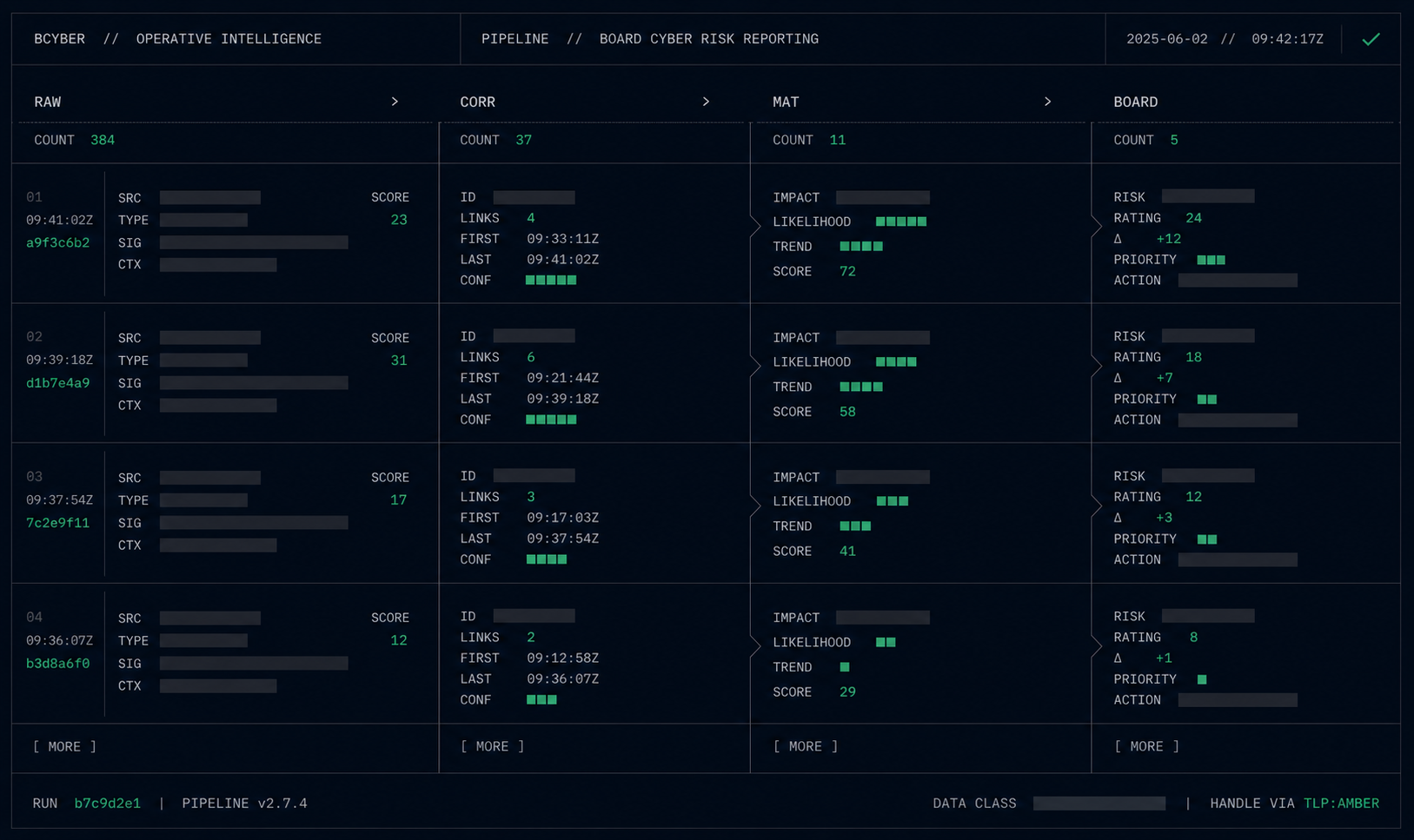
Visuals help decision-makers understand the shape of the problem quickly. Risk heat maps, control gap summaries, cost-versus-risk tables, and scenario comparisons can show priorities at a glance. BCyber’s GRACE Portal is particularly relevant here because its executive reporting and compliance tracking features support board-level communication without turning the discussion into a technical deep dive.
Objections will come, and they should be anticipated. Leaders may ask why the spend is needed now, why this solution is preferred, or what happens if the organisation waits another quarter. They may ask whether existing staff can absorb the work, or how success will be measured after approval. Strong answers rely on evidence, not urgency theatre.
Accountability must be visible as well. The request should identify the business owner, the approver, the delivery lead, and the people responsible for measuring outcomes. Milestones and reporting cadence should be defined before funding is approved, because governance does not end at sign-off.
Measuring outcomes and improving the next funding cycle
Once the spend is approved, measurement becomes part of the value. Key performance indicators and key risk indicators should be defined upfront so the organisation knows what improvement looks like. Performance measures might include mean time to detect, mean time to respond, patch completion rates, or restore success rates. Risk indicators might include the number of critical vulnerabilities, unresolved audit issues, or repeated access exceptions.
Baseline measurement is especially important. If the organisation does not know where it started, it cannot prove whether the investment reduced exposure or just added complexity. Comparing pre- and post-implementation results helps validate the decision and reveals where additional work is needed.
Reporting outcomes back to leadership keeps trust intact. Executives should see progress against milestones, the risk reduction achieved, any unresolved issues, and the business benefits realised. In mature programs, this reporting is often aligned with GRACE Portal dashboards and backed by Paradigm compliance mapping so the board can see how the investment supports both control assurance and risk reduction.
Lessons learned should feed directly into the next planning round. If a control underperformed, the reasons should be captured and addressed. If an assumption proved wrong, the model should be updated rather than defended. Incidents, audits, and tabletop exercises all provide material for refinement, and each cycle should strengthen the organisation’s ability to choose better investments.
Relevant standards and authoritative references
The following sources are useful when preparing a defensible security budget submission:
- APRA CPS 234 – Information Security: https://www.apra.gov.au/cps-234-information-security
- ACSC Essential Eight: https://www.cyber.gov.au/resources-business-and-government/essential-cyber-security/essential-eight
- Australian Cyber Security Centre / Information Security Manual (ISM): https://www.cyber.gov.au/resources-business-and-government/essential-cyber-security/ism
- NIST Cybersecurity Framework 2.0: https://www.nist.gov/cyberframework
- NIST SP 800-30 Rev. 1 – Guide for Conducting Risk Assessments: https://csrc.nist.gov/publications/detail/sp/800-30/rev-1/final
- OAIC – Privacy Act guidance: https://www.oaic.gov.au/privacy/privacy-laws/the-privacy-act
- ISO/IEC 27001:2022: Information security management systems standard
Key takeaways
A board-ready security budget case is built on evidence, not anxiety. It connects assets, control gaps, incident history, and scenario testing to clear business outcomes that leadership can understand and govern. It also frames the cost of inaction honestly, so the board can decide whether the risk being accepted is truly acceptable.
In Australian contexts, that means aligning requests with APRA CPS 234, the Privacy Act 1988, the Essential Eight, and sector-specific obligations where relevant. In financial services, that may mean board reporting on information asset testing and control assurance. In healthcare, it may mean prioritising privacy management and incident response. In government, it may mean strengthening service continuity and aligning to the PSPF/ISM.
The strongest requests offer options, not ultimatums, and explain what each option delivers in terms of risk reduction and operational resilience. They prioritise high-impact controls, avoid tool sprawl, and distinguish tactical fixes from long-term maturity investments. They also make accountability explicit, with owners, milestones, and reporting built in from the start.
Above all, budget justification should be treated as a continuous discipline. Each funding cycle should improve the quality of the inventory, the quality of the risk assessment, and the quality of the decision. That is how an organisation moves from reactive spending to evidence-based security investment. When the case is grounded in proof not promises, leadership gets more than a request; it gets a dependable basis for resilience.