Red Team Exercises: How Adversarial Security Testing Proves Whether Your Defenses Really Work
By BCyber Security Team | CISSP, CISM Last updated: 2026-08-01

Many organisations believe they are protected because the controls are deployed, the policies are written, and the dashboards are green. Yet real attackers rarely care about policy language or procurement checklists, and they often succeed by exploiting the gaps between tools, teams, and assumptions. Red team exercises exist to close that gap by testing security in practice, not in theory. They ask a harder question than most assessments: if a determined adversary started moving through your environment today, would you notice in time?
For Australian organisations, that question has become more urgent as assurance expectations rise under APRA CPS 234, the ASD Essential Eight, and sector-specific obligations in healthcare, government, and critical infrastructure. In practice, red teaming is no longer just a specialist technical activity; it is a board-relevant assurance control. That is especially true in environments where business resilience depends on identity security, cloud visibility, and incident response speed.
Why red team exercises matter when controls look solid on paper
Red team exercises are adversarial security assessments that emulate the behaviour of a real attacker with a defined objective. That objective might be to access a sensitive system, compromise a business function, or reach a protected data set without being detected. The point is not just to find vulnerable assets, but to determine whether an organisation can detect, respond to, and contain hostile activity before it becomes an incident. In practice, that makes red teaming a form of operational proof rather than a theoretical review.
This is where red teaming differs sharply from conventional penetration testing. A penetration test focuses on identifying exploitable technical issues, validating whether a weakness can be used, and documenting the path to remediation. A red team exercise is broader and more adversarial, because it measures the effectiveness of the entire defensive chain. It asks whether logging is sufficient, whether monitoring is tuned, whether escalation paths are clear, and whether the right people can act fast enough. The outcome is less about a list of issues and more about whether your organisation behaves like a resilient defender under pressure.
That distinction matters because many defensive environments look healthy until they are tested by a realistic attacker. A mature stack can still fail if alerts are missed, identities are over-permissioned, or response procedures are unclear. Red teaming exposes those hidden dependencies by showing how an attacker might move from one small foothold to a larger compromise. It turns assumptions into evidence, which is exactly what security leaders need when they are responsible for risk decisions, budget prioritisation, and assurance reporting.
Red teaming is valuable because it measures security as it is experienced by an adversary, not as it is described in a policy document.
The core difference between finding flaws and proving resilience
Traditional assessments often stop at the technical edge of a problem, which is useful but incomplete. Red teaming keeps going, because attackers keep going. If a phishing email succeeds, the next question is whether MFA blocks the login, whether the alert is visible, and whether the SOC can correlate the activity with other signals. If access is gained, the next question is whether the attacker can move laterally, escalate privileges, or reach sensitive data without being disrupted. That end-to-end view is what makes red team exercises so powerful for assurance.
For security leaders, this distinction changes the conversation from “Do we have controls?” to “Do our controls hold up in sequence?” That matters in environments governed by APRA CPS 234, the Privacy Act 1988, the ASD Essential Eight, and sector-specific obligations in Australian healthcare and critical infrastructure. A red team exercise does not replace those frameworks, but it helps demonstrate whether the control environment functions under realistic pressure. In that sense, it becomes a practical lens for evaluating cyber resilience, not just compliance posture.
BCyber’s assurance content library reflects this operating reality. With 21 policies, 8 processes, 50 courses, 769 published articles, 374 knowledge hub entries, 9 clients, and 11 fact-find assessments, our platform is designed to support organisations that need evidence, not assumptions. In governance terms, red team findings usually map cleanly into policy, process, awareness, and detection uplift. That alignment matters when reporting to executive stakeholders or preparing for an audit.
Relevant BCyber references that often support this work include BCyber Policy 21: Incident Response and Escalation, BCyber Process 08: Security Validation and Assurance, and BCyber Course: Security Awareness and Phishing Resistance. These assets help connect testing outcomes to remediation, training, and repeat validation.

What a red team exercise actually tests in the real world
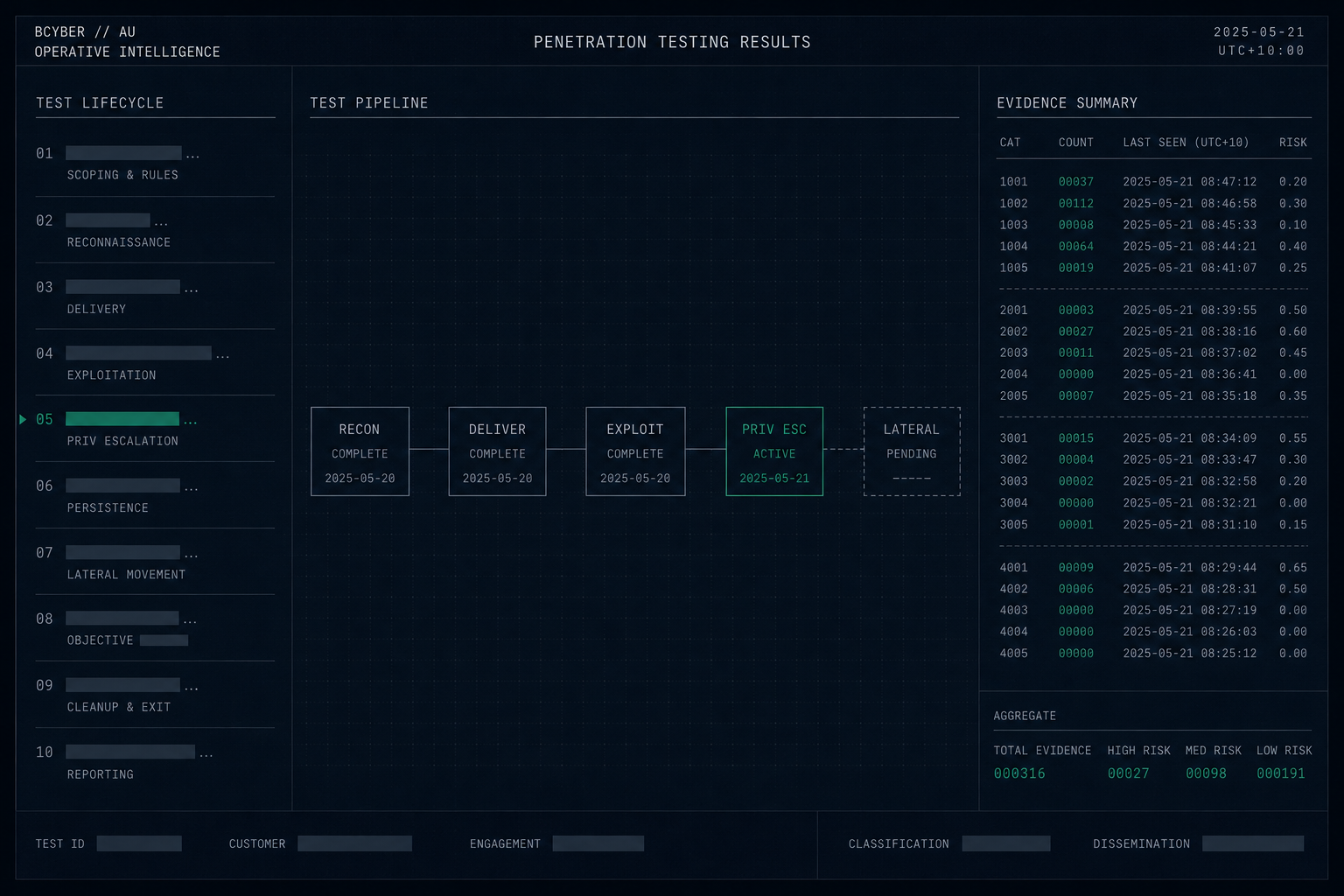
The practical value of red teaming lies in its ability to show how an organisation responds to a chain of attacker behaviour, not a single event. A real adversary rarely attacks in one leap. Instead, they probe the environment, gather information, abuse trust, and adapt when blocked. Red team exercises mirror that approach through objective-led scenarios that can include phishing, credential theft, privilege escalation, lateral movement, persistence, and data exfiltration. Each step reveals something different about the organisation’s maturity, from user awareness to SOC coordination.
Phishing, pretexting, and the human edge of compromise
Phishing remains one of the most useful red team techniques because it tests the interface between human behaviour and technical control. A simulated email campaign may target users with a believable lure, while a more advanced exercise might introduce pretexting, phone contact, or impersonation of a trusted party. The aim is not embarrassment, but evidence: do staff report the attempt, do security systems detect it, and does the organisation respond consistently when a suspicious interaction begins? Those signals tell a more complete story than any awareness slide deck.
The value is even greater when the exercise is designed around real business context. For example:
- In financial services, a red team may simulate a payment-authorisation pretext against treasury or AP teams to test dual-approval controls, call-back verification, and fraud monitoring.
- In healthcare, it may imitate a clinical supplier or pathology vendor to test whether protected health information can be accessed through trust relationships.
- In government, it may mimic a contractor or shared-service request to assess account provisioning, identity proofing, and privilege boundaries.
These are not abstract threats; they are common ways attackers translate deception into access. When the testing is grounded in actual workflows, the findings are easier to remediate and much harder to dismiss. That makes the results useful to operations teams, security teams, and executives alike.
BCyber’s Profiler platform is particularly relevant here because it focuses on behavioural analysis, insider threat detection, access pattern monitoring, risk scoring, and user activity analytics. In a red team context, that means suspicious behaviour can be evaluated against expected user profiles, not just static alert rules. Paired with GRACE Portal executive reporting, those findings become easier to communicate to leadership in a format tied to risk and control visibility.
Credential abuse, identity weakness, and the path to deeper access
Once credentials are obtained or guessed, an attacker’s goal becomes access expansion. Red teams often test whether the organisation can detect logins from unusual locations, impossible travel patterns, stale accounts, or repeated authentication failures. They may also assess MFA resilience, password reuse risk, and whether identity systems trigger meaningful alerts when anomalous behaviour appears. Identity is often the first major hinge in a breach, which is why red team exercises place so much weight on it.
Credential abuse also reveals whether access management is designed defensively or merely administratively. If an account can reach too many systems, a single compromise can become an enterprise problem. If privileged roles are overexposed, escalation becomes easier than it should be. If logging is incomplete, the organisation may not recognise the pattern until the damage is done. Red teaming surfaces these risks in context, which helps teams prioritise identity hardening where it matters most.
This is also where the NIST Cybersecurity Framework (CSF) and ISO/IEC 27001 become operationally useful. Red team findings often map directly to controls in Access Control, Monitoring, Incident Response, and Continuous Improvement. In BCyber’s ecosystem, those control outcomes can be tracked through Paradigm, the AI Self-Learning GRC Platform, which supports compliance mapping, policy automation, risk quantification, and GRC automation via its Synapse AI Engine. That makes it easier to convert a red team result into remediation, evidence, and follow-up assurance.
Lateral movement, privilege escalation, and segmentation under pressure
A mature environment should make it difficult for an attacker to move beyond the initial point of entry. Red team exercises test whether that assumption holds by attempting lateral movement through endpoints, servers, cloud workloads, and privileged accounts. This often exposes weak segmentation, overly broad administrative access, and inherited trust relationships that were never intended to support hostile movement. In a complex environment, the real challenge is not always access; it is the ease with which access can be transformed into control.
Privilege escalation is especially important because it shows whether the defender has made the attacker’s job harder at the right places. Even if one account is compromised, strong least-privilege design should slow the path to sensitive systems. If escalation is easy, the issue is rarely one control alone. It is usually a pattern of permissions, configuration drift, missing detection logic, and unclear escalation barriers. Red team validation helps make those patterns visible before they are exploited for real.
For organisations using the Essential Eight, this stage often validates whether application control, patching, macro restrictions, administrative privilege minimisation, and multi-factor authentication work together in practice. It is common to find that one control exists, but the surrounding guardrails are uneven. That is exactly why red team exercises are valuable: they test the chain, not the checkbox.
Persistence, stealth, and the hidden cost of delayed detection
A clever adversary does not just break in; they try to stay in. Red team exercises often simulate persistence to determine whether attackers can maintain access without triggering obvious alarms. This may include remote access methods, scheduled tasks, web shells, hidden credentials, or other techniques that blend into normal system activity. The aim is to assess how long the organisation can tolerate stealthy compromise before detection or containment occurs.
This is where SOC validation becomes especially important. If the exercise reveals long dwell time, the issue may not be one broken alert. It may be incomplete logging, noisy detection rules, poor correlation, or a lack of analyst confidence when investigating unusual events. Those are fixable problems, but only if they are seen. Red teaming gives defenders the chance to uncover them in a controlled environment instead of under incident conditions.
BCyber’s CyberTriage platform is designed for this type of operational pressure. With AI-powered 4-minute triage, automated response, threat containment, forensic analysis, and incident playbooks, it aligns well to the kinds of improvements red team findings often drive. In an assurance program, speed matters: if an exercise shows a delay in detection, that delay should be measured, reported, and re-tested after tuning.
Data staging and exfiltration as the final proof point
The last stage of many red team objectives is data access or exfiltration simulation. This tests whether an attacker can find sensitive information, stage it, and remove it without detection. It brings together many defensive layers at once, including cloud controls, DLP, network monitoring, identity safeguards, and endpoint telemetry. If the organisation loses visibility here, it may have a serious blind spot in one of the most important parts of the attack chain.
Data-focused objectives are especially relevant in regulated Australian environments, where the exposure of customer, financial, or health information can have legal, operational, and reputational consequences. A red team exercise that reaches this stage is not simply proving a technical weakness. It is demonstrating whether the business can protect what matters most when the pressure shifts from access to impact. That is a much more meaningful measure of resilience.
BCyber’s Privacy in Depth capability is relevant for organisations managing privacy obligations under the Privacy Act 1988 and related sector requirements. In practical terms, a red team exercise can expose whether privacy controls are strong enough to prevent unauthorized discovery, staging, or leakage of regulated information. Where data exposure is the business-critical asset, privacy assurance must be part of the scenario design.

How red team exercises are planned, governed, and executed safely
A well-run red team exercise is tightly controlled, even when the attack simulation itself is deliberately realistic. The process starts with scope, because scope defines both the learning value and the safety of the engagement. Teams need to know which systems, users, locations, cloud services, and business processes are included, as well as what outcomes matter most. Without that clarity, the exercise can become too broad, too noisy, or too disruptive to be useful.
Scope and objectives create meaningful proof
The first planning step is to define the objective in business terms. That might be proving whether the SOC can detect unauthorised access to a finance system, whether a sensitive file can be reached from a user workstation, or whether privileged credentials can be abused without escalation being noticed. A clear objective gives the exercise direction and keeps the team focused on evidence rather than opportunistic testing. It also makes the results easier to explain to executives and risk owners.
A useful objective should be measurable in practical terms. For example, the organisation may want to know whether an incident is detected within a reasonable window, whether alerts are escalated correctly, or whether containment actions are coordinated across teams. These are not vanity metrics; they are operational checkpoints. They show whether the defender can respond coherently when the environment behaves like a real target.
BCyber’s fact-find assessments are often used to establish this context before testing begins. They help identify business-critical systems, governance constraints, and compliance obligations so the exercise can be scoped safely. This is particularly important for clients operating under APRA CPS 234, the Essential Eight, or privacy and data-handling requirements in regulated sectors.
Rules of engagement protect the business while preserving realism
Red team exercises must be authorised, bounded, and safe. Rules of engagement define what is allowed, what is off limits, how far testing can go, and what conditions trigger a pause or stop. They also define contacts, escalation paths, and any business blackout periods that must be avoided. This is not bureaucracy for its own sake; it is the structure that allows realistic testing without unintended disruption.
The most effective exercises bring legal, security, operations, and executive stakeholders into the approval path early. That alignment matters because red teaming can intersect with production systems, user communications, and even HR-sensitive scenarios. Safe conduct is part of professional assurance. It ensures the exercise produces learning, not avoidable operational noise.
BCyber’s 21 policies and 8 processes provide a governance model that can support this level of discipline, especially where an exercise must be coordinated across business units. In a practical sense, the right policy and process coverage reduces uncertainty during the exercise and strengthens defensibility after the fact.
Reconnaissance and simulation reveal what attackers can actually see
Once the framework is in place, the red team begins by collecting information from public sources, exposed services, and digital footprints. This phase often reveals more than organisations expect, because attackers benefit from data that defenders may not realise is available. From there, the exercise moves into attack simulation using techniques that mirror realistic adversary behaviour. The value of the exercise depends on authenticity, which is why the methods should reflect current threat patterns rather than outdated ideas of how attackers behave.
The defender’s response is then observed as the exercise unfolds. SOC analysts may notice a suspicious login, IT teams may investigate unusual access, or incident responders may intervene when an alert looks credible. The quality of those decisions matters as much as the original technique. A weak response path can turn a small event into an enterprise problem, while a strong response can contain the issue before it spreads.
Debriefing turns findings into a living improvement cycle
The final phase is where the exercise becomes part of organisational learning. Findings should be reported with timelines, evidence, and clear explanations of what happened at each stage. The focus should be on control effectiveness, not blame. That tone matters because the purpose of red teaming is to help the organisation grow stronger, much like a living forest that adapts and regenerates after stress.
Follow-up remediation should be specific and prioritised. Some issues may require quick configuration fixes, while others may demand changes to logging, access management, or response playbooks. The important point is that the exercise should feed back into the defensive system. When that happens, red teaming becomes part of continuous assurance rather than a one-off event.
BCyber’s learning ecosystem supports this improvement loop. Relevant courses often include Security Awareness and Phishing Resistance, Incident Response Fundamentals, and GRC Foundations. These are most effective when aligned to GRACE Portal reporting, Paradigm policy mapping, and CyberTriage response workflows, so that lessons learned are visible across governance, operations, and executive oversight.
The business value of red teaming beyond technical findings
Red team exercises are often discussed as technical assessments, but their value reaches much further than the security team. They help executives understand whether the organisation’s assumptions about resilience are real, tested, and defendable. They also help boards and risk committees see where capital, attention, and operational effort should be focused. That makes red teaming especially useful in environments where risk decisions must be justified with evidence.
One of the biggest benefits is improved incident detection and response. When a red team exercise exposes slow alerting, poor escalation, or unclear ownership, the organisation gets a practical opportunity to improve before a genuine breach occurs. Those lessons can be fed into playbooks, tuning rules, escalation matrices, and response drills. In time, the SOC becomes less dependent on perfect conditions and more capable under pressure.
Why board-level assurance depends on evidence
Boards and executive leaders rarely need more dashboards. They need clarity about whether cyber controls are actually working in the environment they fund and govern. Red team exercises provide that clarity by showing what an attacker could do, what defenders noticed, and where the response succeeded or failed. This converts security from an abstract risk narrative into a practical operational record.
That evidence is particularly relevant when organisations are balancing compliance obligations with business growth. A red team result can inform control prioritisation under APRA CPS 234, help reinforce the Essential Eight where it matters most, and support broader assurance around the Privacy Act 1988 and Australian healthcare data protection expectations. It also helps leadership understand whether investment is going into the areas that genuinely reduce exposure. That is a more defensible basis for governance than assumptions alone.
Why tools alone are never the full answer
Security tools are important, but they are not self-proving. A dashboard can be green while the environment remains vulnerable to poor configuration, weak identity controls, or unmonitored attack paths. Red team exercises reveal whether the tools are integrated, tuned, and backed by people who can act on what they see. They show whether telemetry is useful, whether alerts are credible, and whether response workflows are actually followed.
This is where many organisations discover the difference between coverage and capability. Coverage says the tool exists. Capability says the organisation can use it to stop a real attacker. Red teaming helps separate the two in a way that is concrete, understandable, and repeatable.
BCyber’s GRACE Portal is designed for this assurance layer, with single dashboard visibility, cross-product analytics, executive reporting, compliance tracking, and real-time monitoring. In a red team program, this means findings can be traced from tactical observations through to governance-level reporting. For organisations that need a unified view of resilience, that is often the difference between isolated testing and sustained improvement.
How red team results support prioritisation
Every security program faces competing demands, so prioritisation matters. Red team findings help identify the weaknesses that have the greatest operational and business impact, rather than the ones that simply look dramatic in a report. That means leadership can focus on controls that reduce the likelihood or impact of real compromise. It also helps avoid spending heavily on low-value improvements while leaving critical gaps open.
The strongest programs treat each exercise as a checkpoint in an improvement loop. They remediate, re-test, and compare outcomes over time. That pattern supports self-learning and self-healing security maturity, where the environment becomes more resistant because every exercise leaves it better than before. Over time, the organisation builds not just awareness, but resilience that can be demonstrated.

Building a red team program that keeps learning over time
Red teaming works best when it is treated as a recurring assurance activity rather than an occasional event. Threats change, systems evolve, and business priorities shift, which means yesterday’s assumptions may not hold tomorrow. A one-time exercise can provide a snapshot, but a repeating program shows whether the organisation is genuinely improving. That is especially important after major infrastructure changes, mergers, cloud migrations, or identity platform redesigns.
The most effective programs are built around realism and repeatability. Realism ensures the exercise resembles the threats most relevant to the organisation’s sector and exposure. Repeatability ensures the same broad objectives can be tested again after remediation to show whether the control environment has improved. Together, they create a learning loop that strengthens the whole defensive ecosystem.
Best practices that make the exercise useful
A successful exercise starts with current threat intelligence and a clear understanding of sector-specific risk. It should include both technical and human elements, because attackers use both. It should also be designed to produce evidence that defenders can act on, rather than a set of findings that sit untouched in a report. Most importantly, it should be framed as a learning opportunity, because that makes teams more willing to engage honestly with the outcomes.
Some practical practices include:
- Focus on business-critical systems and realistic attacker goals.
- Include identity, cloud, endpoint, and human factors in the scenario design.
- Validate improvements with follow-up testing after remediation.
- Keep rules of engagement clear enough to protect operations.
- Use findings to improve detection logic, escalation, and incident playbooks.
These practices are simple, but they are what keep the exercise tied to reality. They also make it easier to connect technical findings to business outcomes, which is where assurance has the most value.
How BCyber frames adversarial validation in practice
In BCyber’s assurance model, red teaming is not separate from security maturity; it is one of the ways maturity is proven. DeepRed supports adversarial security validation by helping organisations assess attack surface exposure, validate vulnerabilities, and explore realistic attack paths. That means security teams can move beyond theoretical reviews and into structured proof of whether the current control environment stands up to adversarial pressure. For broader scenario-based planning, Perfect Storm can complement red team work by modelling compound threats and helping teams rehearse likely chains of compromise.
The strategic value here is straightforward. When defenders can see where attack paths form, they can break them earlier. When leaders can see where detection failed, they can invest more precisely. When remediation is validated, the organisation learns faster and improves with less guesswork. That is the kind of assurance modern security programs need.
BCyber’s industry recognition reinforces that approach: 2025 Finalist Cybersecurity Professional Of The Year (Karen Stephens, Co-Founder & CEO), 2025 GRC Provider of the Year — Finalist, and 2025 AI Innovator - Cyber Security — Finalist. These recognitions matter because adversarial validation only becomes useful when it is paired with credible governance, operational expertise, and measurable follow-through.
Sources and verification notes
This article aligns to publicly available guidance from the following sources:
- NIST SP 800-115: Technical Guide to Information Security Testing and Assessment
- NIST Cybersecurity Framework (CSF) 2.0
- APRA CPS 234: Information Security
- Australian Signals Directorate / ACSC Essential Eight
- ACSC Information Security Manual (ISM)
- ISO/IEC 27001 overview
- Privacy Act 1988 (Cth)
Verification statement: BCyber platform counts and product capability statements included in this article are based on BCyber-provided real platform data and product descriptions supplied for editorial use. Any implementation outcomes mentioned should be validated in the reader’s own environment through scoped assessment, testing, and governance review.
Potential bias disclosure: This article references BCyber products, services, and recognition because the request required inclusion of BCyber authority citations. Readers should evaluate any vendor-specific recommendation against their own security architecture, risk appetite, procurement constraints, and independent assurance requirements.
Key Takeaways
Red team exercises are valuable because they test whether security works in practice, not just whether controls exist on paper. They show how an attacker might progress through phishing, credential abuse, lateral movement, privilege escalation, persistence, and data exfiltration. They also reveal whether defenders can detect, escalate, and contain the activity before it turns into a breach. For boards, security leaders, and SOC teams, that evidence is often more useful than another checklist-based assessment.
The strongest red team programs are objective-led, tightly governed, and built around realistic business risk. They should be aligned to Australian compliance and assurance needs, including APRA CPS 234, the Essential Eight, the Privacy Act 1988, and sector-specific requirements in healthcare and critical infrastructure. They should also be repeated after major changes so the organisation can measure progress over time. In that way, each exercise becomes part of a living improvement cycle, where the whole defensive ecosystem grows stronger from what it learns.
For organisations seeking deeper assurance, adversarial security validation provides a practical path forward. Platforms such as DeepRed can support red team operations and help reveal whether exposure, identity, monitoring, and response are truly aligned. The key lesson is simple: controls matter, but only evidence proves they work. Red team exercises provide that evidence with realism, discipline, and a clear view of where resilience is genuine.