CISO Strategy and Leadership: Part 1 — Governance, Accountability, and Cyber Risk Alignment
By BCyber Security Team | CISSP, CISM Last updated: 17 September 2026

CISO strategy and leadership is no longer confined to technical defence, incident response, or control tuning. In modern organisations, it is a governance discipline that shapes how cyber risk is identified, discussed, owned, and managed across the business. The strongest CISOs do not simply ask whether a control works; they ask whether the organisation can prove its posture, justify its decisions, and align security effort with what matters most to the enterprise.
That shift matters because cyber risk now sits beside financial, operational, legal, and reputational risk in the boardroom. In Australia, that expectation is reinforced by APRA CPS 234 for information security, the ASD Essential Eight for baseline hardening, and privacy obligations under the Privacy Act 1988. In practice, this means the CISO must help the business move from “we think we’re covered” to “we can demonstrate control effectiveness, accountability, and risk treatment.”
In Part 1, the focus is governance—the foundation that makes effective CISO strategy possible.
Verification note: References to BCyber platform scale in this article are based on internal platform inventory data current at publication: 23 policies, 9 processes, 50 courses, 933 published articles, 504 knowledge hub entries, 10 clients, and 14 fact-find assessments.
Cybersecurity Leadership Begins Where Business Risk Begins
Cybersecurity has moved well beyond the IT department, because the outcomes of a weak security posture now affect revenue, service delivery, regulatory standing, and customer trust. A modern CISO is expected to understand how the business creates value, where it is exposed, and which dependencies could interrupt operations. That means security leadership is not about defending every system equally; it is about protecting the business capabilities that keep the organisation viable.
For example, in financial services, the most material cyber risks are often tied to identity compromise, payment disruption, privileged access abuse, and third-party service failure. Under APRA CPS 234, entities are expected to maintain an information security capability commensurate with vulnerabilities and threats, and to notify APRA of material information security incidents in a timely way. In healthcare, the exposure may be different: ransomware, availability loss, and privacy breaches affecting patient records can have immediate operational and safety implications. In government, the focus often extends to citizen trust, service continuity, and data sovereignty, with control expectations shaped by the Protective Security Policy Framework (PSPF), Information Security Manual (ISM), and ASD guidance.
When cyber decisions are made without business context, teams often spend time on low-value controls while missing the risks that would truly hurt. Governance keeps that from happening by anchoring cyber strategy to business priorities.
The CISO role, at its best, is the bridge between technical reality and executive decision-making. Leaders need more than reassurance, because reassurance does not stand up to audit, incident pressure, or board scrutiny. They need evidence, structured risk discussions, and a decision path that shows how security choices were made.
In BCyber’s operating model, that bridge is supported through the GRACE Portal (Unified Cyber Resilience Platform), which provides a single dashboard, cross-product analytics, executive reporting, compliance tracking, and real-time monitoring. GRACE is designed to give leadership a shared view of posture across governance, risk, resilience, and response. It also connects naturally with BCyber’s Paradigm AI Self-Learning GRC Platform, which supports policy automation, compliance mapping, and risk quantification.
CISO leadership therefore rests on five governance responsibilities that work together like roots in a living forest:
- Strategic alignment ensures security effort supports enterprise objectives.
- Risk governance creates a repeatable way to assess and manage exposure.
- Accountability and decision rights make ownership clear.
- Board and executive reporting translates posture into business language.
- Evidence-based assurance proves the organisation is doing what it says it is doing.
Together, these responsibilities turn cybersecurity from a reactive function into a managed business capability.
Governance gives security its structure
Without governance, security teams often become trapped in a cycle of urgency. Every alert feels important, every vulnerability seems equal, and every business unit wants a different answer. Governance creates the structure that allows the organisation to separate noise from risk and action from theatre. It also helps security move from isolated technical work to a shared operating model that can survive audits, incidents, and leadership change.
In a strong model, each decision becomes traceable, and each control has a reason for existing. That is especially important where organisations must demonstrate alignment to ISO/IEC 27001:2022, the NIST Cybersecurity Framework, or industry-specific obligations. A policy set without operating discipline rarely survives scrutiny; a governed model with evidence usually does.
Security maturity is not the same as security activity. Activity without governance can look busy while remaining strategically weak.
Strategic Alignment Connects Security to the Enterprise
A CISO cannot lead effectively if cybersecurity is treated as a parallel universe. Security priorities must map to business strategy, because the organisation is not buying controls for their own sake. It is protecting customer trust, service continuity, intellectual property, regulated data, and the systems that drive revenue.
That means the CISO must understand the business model in practical terms: what generates income, which processes are critical, where the organisation depends on third parties, and which data assets would cause the greatest harm if exposed or lost. When these realities are visible, security investment becomes easier to justify and easier to sequence.
Strategic alignment also prevents organisations from confusing visible effort with meaningful protection. A tool deployment may look impressive, but if it does not reduce exposure to a material business scenario, it may not be the right investment. Strong governance helps leaders decide what risks to accept, reduce, transfer, or monitor. That decision framework matters because not every risk can be eliminated, and trying to do so often wastes resources that could have been used elsewhere. The CISO’s job is to help leadership make risk decisions deliberately rather than implicitly.
Mapping security priorities to business objectives
Security initiatives should be linked to outcomes the business already cares about, such as resilience, customer retention, regulatory compliance, and trusted growth. If a control hardens a system but does not reduce material business exposure, it may still be useful, but it should be framed honestly. For example, protecting customer identity data is not just a technical priority; it supports brand confidence, reduces breach impact, and protects the organisation’s ability to retain and serve customers.
In practice, this means each major security investment should be able to answer a simple question: which business outcome does this protect or enable? That discipline turns security into a decision-making function rather than a tool collection exercise.
A practical way to maintain alignment is to review cyber priorities alongside enterprise planning cycles. If the business is entering a cloud transformation, expanding into a new market, or changing supply chains, the security function should be part of that conversation from the start. This is where the CISO becomes a strategic partner rather than a downstream reviewer. Security integrated early can shape architecture, vendor selection, and control design before risk is locked in. The result is usually lower friction, better resilience, and fewer expensive retrofits later.
BCyber’s Perfect Storm scenario intelligence capability is particularly relevant here. Its scenario modelling and simulation functions help organisations test compound threats, such as ransomware plus identity compromise or supplier outage plus cloud misconfiguration. That kind of analysis supports board-level conversations about resilience, business impact, and control priority.
Understanding risk appetite and tolerance
Risk appetite, tolerance, and threshold are related but not interchangeable.
- Risk appetite is the amount of risk the business is willing to take to pursue its objectives.
- Risk tolerance describes how much variation from the desired state is acceptable before action is needed.
- Thresholds are the measurable limits that trigger review or escalation.
When a CISO understands these distinctions, they can guide control design and investment choices with much greater precision. Without them, security teams often over-engineer some areas while leaving other exposures under-managed.
In a mature governance model, appetite and tolerance shape where controls are strong, where exceptions are acceptable, and where residual risk requires executive sign-off. This is particularly useful when business leaders want speed, but the security posture has not yet caught up. Rather than saying yes or no in a vacuum, the CISO can show the operational and risk consequences of moving forward. That gives decision-makers a real choice. It also prevents security from becoming the department of delay, which is a common reason executives bypass it.
Prioritising critical assets and dependencies
The most effective CISOs focus on the systems and services that would cause the highest business impact if disrupted. Those assets are not always the most obvious technical systems. They may include identity infrastructure, cloud control planes, SaaS collaboration platforms, payment workflows, or third-party service dependencies that the business assumes are stable.
In many organisations, the real exposure sits in shared services and invisible dependencies rather than in the most visible applications. Governance forces those relationships into view.
A useful prioritisation method is to map business services to the assets that support them, then trace the dependencies behind each one. That includes cloud hosting, software suppliers, managed service providers, privileged accounts, and data flows across environments. When the business understands how those dependencies connect, it becomes easier to justify controls like multifactor authentication, segmentation, backup testing, and vendor assurance. It also helps the organisation decide which risks are acceptable for now and which require immediate treatment.
That is strategic alignment in action: not every risk is equal, and not every control deserves the same urgency.

Risk Governance Turns Exposure Into Managed Decisions
A strong CISO does not only identify risks; they build a repeatable process for managing them. Risk governance is the mechanism that makes cyber exposure visible, comparable, and actionable across the business. It starts by defining how risk is identified, how it is assessed, who reviews it, and how decisions are recorded. This is important because cyber risk is rarely static. New vulnerabilities, configuration changes, supply chain shifts, and human error can alter the picture quickly, so the governance model must be able to absorb change without losing clarity.
The goal of risk governance is not to eliminate every threat. That would be unrealistic, expensive, and often counterproductive. The real objective is to ensure that risk is managed intentionally, with enough evidence to support executive and board-level decisions. A consistent taxonomy, clear scoring model, and regular review cadence allow the organisation to compare one risk against another and prioritise the highest-impact items first. This is how cyber risk becomes part of enterprise risk management rather than a separate technical list.
BCyber’s Paradigm platform is designed for exactly this kind of repeatable governance. Its Synapse AI engine supports self-learning security posture management, while policy automation and compliance mapping help reduce manual drift across frameworks such as APRA CPS 234, ISO 27001, and Essential Eight-aligned uplift programs.
Identifying cyber risk sources
Risk can emerge from many places, and a good governance model assumes that exposure will come from both inside and outside the organisation. Common sources include vulnerabilities, misconfigurations, unsupported systems, poor identity controls, third-party failures, malicious activity, and simple human error. Legacy systems are often especially important because they can remain embedded in critical workflows even when they no longer receive adequate support. The CISO should ensure that each of these sources is tied back to a business process or asset, so the organisation understands why it matters. This creates a more accurate picture of impact.
A practical example is a customer-facing portal hosted in cloud infrastructure and integrated with a third-party payment provider. A vulnerability in the portal matters, but so does the identity architecture, the supplier’s incident response capability, and the backup pathway if the service becomes unavailable. Risk identification is therefore not just about listing weaknesses. It is about tracing how a weakness could affect a service the business depends on. That approach leads to better prioritisation and more useful remediation plans.
For insider risk and access misuse, BCyber’s Profiler platform adds behavioural intelligence. Its user activity analytics, access pattern monitoring, and risk scoring capabilities help organisations identify anomalous behaviour that traditional perimeter controls may miss. This is particularly relevant in finance and healthcare, where privileged access and sensitive record handling are frequent audit focus areas.
Assessing and prioritising risk
Risk assessment works best when technical findings are translated into business language. A vulnerability is only truly meaningful when it is linked to likely impact, control weakness, and operational consequence. A mature assessment considers financial loss, service disruption, legal exposure, reputational damage, and in some sectors, safety implications. It also weighs control effectiveness, because two organisations with the same vulnerability may carry very different levels of actual risk. The CISO’s role is to make those differences visible.
Priority should be based on a combination of likelihood, impact, and the strength of existing controls. That means a medium-severity issue affecting a critical business process may deserve more attention than a high-severity issue in a low-value environment. This is where governance helps avoid security theatre. Instead of chasing the loudest alert, the organisation can invest where it will materially reduce exposure. The best risk programs do not just generate scores; they create decision-quality information.
BCyber’s TopSpin analytics hub can support this process by helping security leaders forecast storage growth, identify trend shifts, and improve capacity planning. In practice, that matters because data growth, log retention, backup design, and storage economics directly affect resilience and the cost of maintaining evidence for investigations and compliance.
Treating risk with intention
Once a risk is understood, leadership must decide how to treat it. The main options are to reduce, accept, transfer, avoid, or monitor the risk. Each choice has consequences, and governance is what makes the choice visible and accountable. If a risk is accepted, the decision should be explicit, documented, and signed off by the appropriate business owner. If it is reduced, the remediation plan should have a timeline, funding path, and accountable owner. If it is transferred, the organisation should understand what the transfer does and does not cover.
This is where the CISO’s advisory role becomes especially important. The CISO should not be the sole owner of every business risk, because that would blur accountability and weaken governance. Instead, the CISO provides the analysis, options, and evidence that enable informed decisions. Business leaders then own the residual risk because they own the outcomes. That separation is essential, especially when the organisation is under audit or facing an incident review.
Keeping the risk register alive
A risk register should function like a living system, not a static spreadsheet. Risks should be reviewed on a cadence that matches their urgency, with high-priority items tracked more frequently than low-priority ones. Each entry should include the risk statement, business impact, current controls, treatment plan, owner, due date, and escalation path. When these fields are consistently maintained, the register becomes a powerful governance tool rather than a record of forgotten issues. It shows whether the organisation is learning, adapting, and improving.
Regular cadence matters because risks change as the environment changes. New suppliers are onboarded, systems are replaced, work patterns shift, and threat actors adapt. A living risk register captures those changes and keeps the business honest about what has improved and what has not. That is the self-learning principle in practical form: the system gets better because it keeps absorbing evidence and acting on it. Over time, the organisation builds a more resilient understanding of itself.
BCyber’s GRACE Portal is built to unify these records so leaders can track governance, risk, and compliance from one control plane. It becomes especially useful when combined with CyberTriage, which delivers AI-powered incident response and rapid triage for faster containment and investigation. In a mature operating model, risk governance and incident response should not be separate silos; they should inform each other continuously.

Accountability and Reporting Make Governance Real
Security fails when ownership is vague. If everyone assumes someone else is handling the problem, the organisation ends up with gaps that no tool can fix. That is why accountability and decision rights are central to CISO leadership. Governance must define who owns the risk, who owns the control, who approves exceptions, who funds remediation, and who can accept residual exposure. When these boundaries are clear, action becomes faster and conflict becomes easier to resolve.
The CISO should coordinate this structure, but not absorb every responsibility into the security team. Business owners must own business risk decisions, because they are the ones accountable for the service, the revenue, or the regulatory obligation affected. The CISO supports those decisions with analysis and evidence. This model is especially useful in larger organisations where IT, operations, compliance, procurement, HR, and legal all influence the security outcome. A shared operating model makes those relationships visible before an incident forces them into the open.
Defining ownership and decision rights
A practical governance model separates business owners, control owners, and risk owners.
- The business owner is accountable for the outcome and the service.
- The control owner is responsible for implementing or operating a specific safeguard.
- The risk owner is the person who accepts the residual risk if it remains after treatment.
This distinction prevents confusion and avoids the common trap where security is asked to own risks it cannot actually control. It also supports better auditability, because each decision can be traced to the right person.
RACI models can help when responsibilities are complex. They provide a simple way to define who is Responsible, Accountable, Consulted, and Informed. Used well, this is not bureaucratic overhead; it is operational clarity. It reduces delay in incidents, projects, and approvals because people know where they stand. It also helps new team members, auditors, and executives understand how the security function fits into the wider business.
Reporting cyber risk in business terms
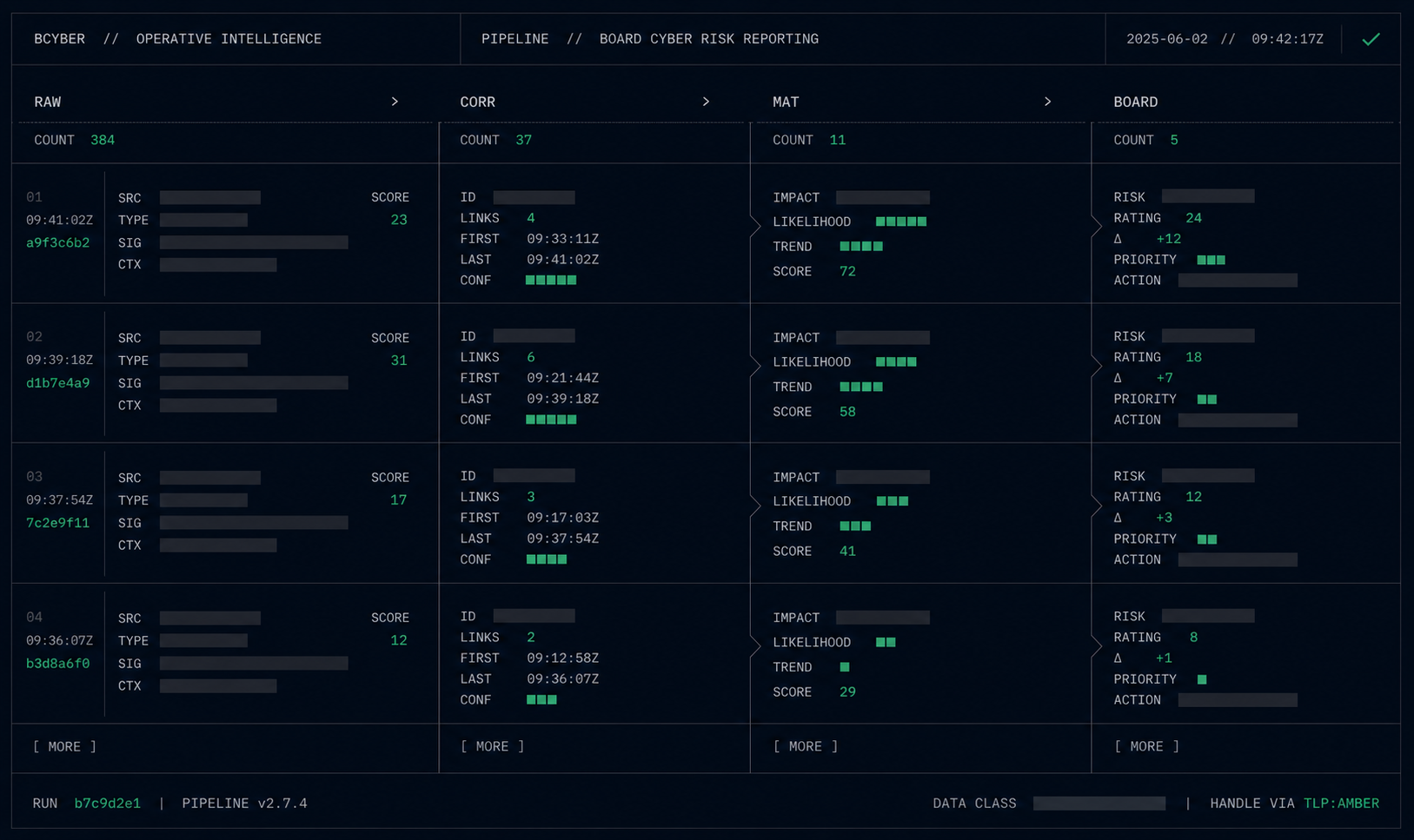
Boards do not need a flood of technical detail. They need a clear picture of material risk, emerging trends, and the decisions that require executive attention. Good reporting answers three questions: what is our current risk, are we improving, and what do we need to decide? That usually means showing top risks, key control gaps, remediation status, incident trends, and the organisation’s readiness against likely threat scenarios. It also means avoiding reports that are heavy on activity and light on consequence.
Useful metrics tend to focus on control health and business relevance. Examples include patch remediation performance, identity and access control maturity, third-party risk status, incident response readiness, and control exceptions that remain open beyond agreed tolerance. These indicators are more valuable than raw counts because they show direction and effect, not just volume. The aim is to help executives understand whether the organisation is becoming safer in ways that matter. Reporting should illuminate, not obscure.
Metrics are most useful when they explain change, not when they merely record motion.
Evidence-based assurance strengthens trust
Leadership confidence rises when reporting is backed by evidence. That evidence may include policies, control test results, audit findings, incident records, risk acceptance forms, training completion, and remediation proof. In a regulated environment, assurances without evidence are fragile because they cannot survive scrutiny. Evidence gives the CISO credibility with the board, regulators, auditors, insurers, and customers. It also supports faster recovery when something goes wrong, because the organisation can immediately show what was in place and what was being improved.
BCyber’s content and learning ecosystem helps support this assurance model in practice:
- 23 policies and 9 processes provide structure for governance and control ownership.
- 50 courses support awareness and role-based uplift.
- 933 published articles and 504 knowledge hub entries help teams operationalise guidance.
- 14 fact-find assessments support discovery, baselining, and improvement planning.
Where relevant, BCyber clients commonly align to APRA CPS 234, the Essential Eight, ISO/IEC 27001, and privacy obligations under the Privacy Act 1988. In regulated environments, these frameworks provide the control language that makes assurance portable across audits, executive reporting, and third-party assurance discussions.
Assurance should not be limited to periodic review. Where possible, it should move toward continuous monitoring and validation using logs, alerts, telemetry, and automated checks. That is where self-healing principles become relevant. If a control failure is detected early and the organisation already has a documented response pathway, correction can begin before exposure widens. In practice, this means cybersecurity governance becomes part of the operating rhythm rather than a compliance event.
A Sustainable CISO Operating Model Embeds Security Into the Business
The final test of CISO strategy is whether it survives beyond one person, one crisis, or one reporting cycle. That requires an operating model that makes governance repeatable. The model should define how decisions are made, how often risks are reviewed, how controls are assured, and how exceptions are escalated. It should also connect security to enterprise risk management, compliance activity, and business planning. When that happens, cybersecurity stops being an isolated function and becomes part of how the organisation runs.
An effective operating model usually includes policies, standards, risk frameworks, committees, KPIs and KRIs, control ownership, and assurance routines. It also embeds security into change management, vendor onboarding, product delivery, and transformation programs. This “shift left” approach means risk is considered early, when decisions are still flexible. It is far easier to design secure systems than to retrofit them after launch. Governance supports that early intervention by placing the right questions at the right point in the business lifecycle.
BCyber’s Privacy in Depth capability supports end-to-end privacy management for the Australian Privacy Act environment, helping organisations operationalise privacy obligations alongside cyber governance requirements. That matters because privacy, security, and resilience now overlap in most board discussions, particularly where personal information, critical services, or regulated records are involved.
Common failures are usually predictable. Ownership is unclear, reporting is fragmented, technical teams carry too much of the burden, escalation is inconsistent, and evidence is incomplete. Another common issue is that security remains separate from enterprise risk conversations until a problem becomes visible. Those gaps weaken the organisation’s ability to learn from experience.
A mature CISO operating model closes them by creating shared rhythm, shared language, and shared accountability.
Why BCyber’s approach is relevant
BCyber’s CyberSuite ecosystem is designed to support governance-led cybersecurity operations across the full lifecycle:
- GRACE Portal for unified visibility and executive reporting
- Paradigm for AI-enabled GRC automation
- Profiler for behavioural risk and insider threat detection
- TopSpin for forecasting and capacity-driven security decisions
- CyberTriage for rapid incident response
- Perfect Storm for scenario intelligence and resilience testing
- Privacy in Depth for privacy compliance and data governance
BCyber was also recognised as a 2025 Finalist — Cybersecurity Professional of the Year for Karen Stephens, Co-Founder & CEO, and named a 2025 Finalist — GRC Provider of the Year and 2025 Finalist — AI Innovator in Cyber Security. These recognitions reflect growing industry interest in governance automation, scenario-based resilience, and AI-assisted cyber operations.
Practical governance examples by sector
A few real-world scenarios show why governance matters:
- Financial services: A bank preparing for a core banking migration must define who owns risk acceptance for legacy system exposure, who signs off on identity controls, and how CPS 234 control effectiveness will be evidenced during the transition.
- Healthcare: A hospital network managing third-party clinical software should map vendor uptime, data handling obligations, and incident notification pathways before rolling out changes that affect patient records.
- Government: A public sector agency handling citizen services needs clear decision rights for privileged access, cloud hosting assurance, and Essential Eight uplift milestones, especially where multiple delivery partners are involved.
In each case, the technology matters, but governance determines whether the technology is controlled, explainable, and auditable.
Key Takeaways
CISO strategy and leadership begins with governance, because governance turns cybersecurity into something the business can actually manage. The CISO must align security priorities with enterprise goals, risk appetite, and operational dependencies so that effort is focused on what matters most. Risk governance then makes cyber exposure visible and repeatable, allowing the organisation to identify, assess, treat, and review risks in a structured way.
Accountability and decision rights ensure the right people own the right decisions, while board reporting translates technical posture into business terms that support action. Finally, evidence-based assurance gives the organisation the ability to prove its posture, not just describe it, which is essential in regulated and high-risk environments.
When these elements work together, cybersecurity becomes a governed business capability rather than a reactive technical function. That is the real foundation of CISO leadership.
In Part 2, the focus shifts from governance to execution: how CISOs build capability, drive operational resilience, and make strategy real in day-to-day practice.
Sources and references
For further reading, see:
- APRA CPS 234 — Information Security: https://www.apra.gov.au/information-security-cps-234
- ASD Essential Eight maturity model: https://www.cyber.gov.au/resources-business-and-government/essential-cyber-security/essential-eight
- ACSC guidance and alerts: https://www.cyber.gov.au/
- NIST Cybersecurity Framework: https://www.nist.gov/cyberframework
- NIST SP 800-37 Risk Management Framework: https://csrc.nist.gov/publications/detail/sp/800-37/rev-2/final
- ISO/IEC 27001 overview: https://www.iso.org/isoiec-27001-information-security.html
- Privacy Act 1988 (Australia): https://www.oaic.gov.au/privacy/the-privacy-act