CISO Strategy and Leadership: How to Align Cybersecurity With Business Goals and Prove Risk Reduction

By BCyber Security Team | CISSP, CISM Last updated: 16 June 2026
Disclosure: This article references BCyber products, internal platform inventory, and implementation experience. The guidance is informed by public frameworks and BCyber’s operational work; it is not legal advice or a substitute for regulatory counsel.
Cybersecurity has outgrown the server room. Today, the CISO is expected to operate as a business leader who can translate risk into language executives understand, shape decisions across the organisation, and prove that security investments are reducing exposure in practice. That means moving beyond tool administration and incident response into governance, accountability, and measurable improvement. It also means building a cybersecurity capability that supports growth, resilience, and trust rather than slowing the business down.
In Australia, that mandate is anchored by real regulatory and assurance expectations: APRA CPS 234 for financial services resilience, the ACSC Essential Eight for uplift priorities, and the Privacy Act 1988 for lawful handling of personal information. For many organisations, the most effective operating model also maps well to the NIST Cybersecurity Framework 2.0 and ISO/IEC 27001 because both give the business a structured way to govern, measure, and improve cyber maturity (APRA CPS 234, Essential Eight, NIST CSF 2.0, ISO 27001, OAIC Privacy).
From security operator to business leader
The modern CISO mandate
A modern CISO is not simply the person who owns alerts, policies, or the annual penetration test. The role now sits at the intersection of enterprise risk, business continuity, regulatory readiness, and operational resilience. That shift matters because the business is not buying “security” in the abstract; it is buying confidence that critical processes, customer data, and strategic operations will keep functioning under pressure.
A financial services CISO, for example, may be asked to prove that control effectiveness is commensurate with APRA CPS 234 obligations, that third-party exposure is tracked, and that material incidents are triaged and escalated fast enough for board and regulatory scrutiny. In healthcare, the same leader may need to protect clinical availability, patient data, identity integrity, and auditability while operating against ransomware pressure and strict privacy obligations. In government-adjacent environments, the focus may shift toward standardised baselines, access governance, and demonstrable adherence to the Essential Eight.
That is why strategy separates leadership from administration. Tactical security management focuses on keeping systems patched, logs collected, and incidents contained, which is necessary but incomplete. Strategic cybersecurity leadership asks which threats matter most, which assets are truly critical, where the business can tolerate risk, and how to direct scarce effort toward the highest-value protections. It is the difference between being busy and being effective. It is also the difference between reporting activity and proving risk reduction.
Why governance gives strategy weight
Governance is the mechanism that turns cyber intent into repeatable action. Without it, even a strong strategy becomes a collection of disconnected projects, each competing for attention and budget. A strong governance model defines ownership, escalation paths, policy lifecycles, and the process for accepting exceptions when business realities do not match ideal controls.
In BCyber’s internal platform inventory, the governance layer is supported by 21 policies and 8 processes, which is a useful reminder that maturity is not about policy volume alone; it is about how consistently leaders apply, review, and evidence those controls. The same principle underpins frameworks such as ISO/IEC 27001 and NIST SP 800-37’s risk management approach: governance only works when decision rights and evidence are explicit (NIST SP 800-37 Rev. 2).
Boards and executives do not need a catalogue of every security control. They need to know whether the organisation understands its most material cyber risks, whether leaders are making informed trade-offs, and whether evidence supports the current posture. A CISO who can show the logic chain from business objective to control to evidence earns a very different level of trust. That trust becomes the foundation for faster decisions when change, incidents, or audits arrive.
What executives and boards need to see
Executives usually want three things from their CISO: clarity, prioritisation, and confidence. Clarity means understanding where the business is exposed and what is being done about it. Prioritisation means seeing which risks are being addressed first and why some items are being deferred. Confidence means having evidence that the security function is not relying on assumptions, wishful thinking, or a stack of tools that have never been validated.
The best CISOs answer in outcomes, not slogans. For instance, “we improved detection” is weaker than “we reduced mean time to triage for high-severity events, improved privileged account review coverage, and closed the control gaps that created repeat audit findings.” That kind of language matters in sectors where assurance is part of the operating model.
For Australian boards, the expectation is increasingly evidence-led governance. APRA-regulated entities need to show security capability that keeps pace with threat exposure; Essential Eight uplift programs need to show progress against maturity targets; and privacy obligations require demonstrable handling of data subject rights, retention, and access controls. In practice, those requirements converge on the same question: can the CISO prove that risk is going down?
Aligning cyber priorities to business objectives
Start with objectives, not controls
Security strategy should begin with the business plan, not the technology stack. If the organisation is moving to cloud-first operations, then identity governance, SaaS oversight, and configuration control should rise above legacy perimeter thinking. If the business is handling sensitive customer information or regulated records, then privacy, encryption, retention, and audit trails become strategic priorities. If the company is expanding rapidly, cyber due diligence, integration security, and standardised onboarding of new environments become critical.
That alignment only works when the CISO translates corporate goals into risk scenarios the business can understand. For example, “improve customer experience” may depend on digital availability, trusted identity, and low-friction access. “Accelerate market expansion” may depend on secure onboarding of new staff, systems, and vendors. “Reduce operational waste” may expose the business to inconsistent control implementations if shadow IT has filled gaps for years.
This is also where framework alignment becomes useful. NIST CSF 2.0’s Govern function helps executive teams define oversight and accountability, while the Identify / Protect / Detect / Respond / Recover functions help operational teams connect security work to business outcomes. ISO/IEC 27001 provides a similar discipline through an ISMS model, and APRA CPS 234 forces a sharper, more accountable view of control capability in regulated environments.
Map critical assets and risk scenarios
A useful cyber strategy starts with a map of the organisation’s critical assets and high-value processes. That map should identify the systems, data, identities, and third parties that would cause the most disruption if they failed, were compromised, or were made unavailable. It should also show the business processes that depend on them, because technology without process context can be misleading.
A payroll system, for instance, is not just an application; it is part of a trust relationship with staff, finance, and operations. A clinical records platform is not just a database; it is part of patient safety, continuity of care, and privacy compliance. A payments platform is not just a transaction engine; it is a revenue and liquidity dependency. When those dependencies are visible, risk conversations become much more grounded.
From there, the CISO can build realistic risk scenarios rather than abstract lists of controls. A ransomware event, a supplier compromise, a privileged account misuse incident, or a cloud misconfiguration all look different at the board level when tied to specific business impacts. The value of that approach is that it allows the organisation to prioritise based on consequence, not just likelihood. It also helps avoid the trap of treating every security issue as equally urgent. When everything is critical, nothing is.
Tailor the strategy to the operating model
Different operating models demand different strategic choices, and a good CISO recognises that one-size-fits-all security rarely works. A cloud-heavy business may invest heavily in identity, conditional access, logging, and configuration baselines, because those are the control points that matter most. A heavily regulated business may focus on retention, encryption, segregation, and evidence collection to support auditability and legal defensibility. An acquisition-driven organisation may need repeatable assessments, clean integration patterns, and standardised remediation pathways to stop inherited risk from multiplying.
A healthcare provider, for example, may treat access reviews, MFA, and break-glass account monitoring as high-priority controls because clinical downtime has immediate operational and safety consequences. A financial services organisation may focus more heavily on third-party assurance, critical data protection, and incident notification readiness. A government contractor may prioritise baseline hardening, secure configuration, and measurable Essential Eight uplift.
Good cybersecurity strategy is not a list of best practices. It is a set of decisions about what the business must protect first, what it can tolerate for now, and how it will prove those decisions were made responsibly.
This is where prioritisation becomes a discipline. The CISO cannot fix everything at once, and pretending otherwise creates shallow progress. Instead, the strategy should identify a small number of risk themes that matter most, then connect them to funded initiatives, accountable owners, and measurable outcomes. When that discipline is in place, security stops being a backlog and starts becoming a managed business program.
Building governance, risk appetite, and accountability
Defining cyber risk appetite
Risk appetite is often discussed as if it were a boardroom slogan, but it is really a decision-making boundary. It defines how much cyber risk the organisation is willing to accept in pursuit of its goals, and where it expects leaders to escalate rather than absorb uncertainty.
A clear risk appetite helps the CISO determine which issues require immediate remediation, which can be managed through compensating controls, and which may be formally accepted by business owners. Without that boundary, every decision becomes emotional or political. With it, decisions can be consistent and traceable.
Governance brings that appetite to life through policy, standards, and exception handling. Policies describe what must happen, standards describe how it should happen, and exceptions explain when reality forces a different path. The important part is not that exceptions exist, but that they are visible, time-bound, and approved by the right decision-maker.
That discipline is especially important where controls intersect with APRA CPS 234 expectations, Essential Eight uplift programs, privacy obligations, and healthcare data protection requirements. Good governance does not eliminate complexity, but it stops complexity from becoming disorder.
Setting accountability and decision-making structure
The CISO should never be the only person responsible for cyber risk, because cyber risk is an enterprise issue. Accountability needs to be distributed across the business, with clear decision rights for IT, operations, finance, legal, privacy, HR, procurement, and executive leadership. Each function has a role in controlling exposure, whether that means protecting data, managing access, reviewing vendors, training staff, or funding remediation.
Shared ownership is also where BCyber’s platform ecosystem is most relevant. The GRACE Portal acts as a unified cyber resilience hub with a single dashboard, cross-product analytics, executive reporting, compliance tracking, and real-time monitoring. In practice, that gives leadership one operating view rather than a patchwork of disconnected reports.
Below the dashboard layer, Paradigm supports GRC automation, risk quantification, policy automation, and compliance mapping with its Synapse self-learning engine. Profiler adds behavioural intelligence for access anomalies and insider-threat indicators. CyberTriage delivers AI-powered incident triage in around 4 minutes, which is especially valuable when the board wants rapid containment, not a long investigation queue. Perfect Storm helps leaders run scenario modelling and war-gaming before a real crisis, while TopSpin supports trend analysis and capacity planning. Privacy in Depth supports privacy management aligned to Australian privacy obligations, including the Privacy Act 1988.
A useful governance model includes three layers of decision-making. Operational teams handle the day-to-day control work, risk owners make trade-off decisions within agreed limits, and executives or the board handle material exceptions and strategic direction. That structure keeps the CISO focused on orchestration rather than becoming the single point of failure. It also supports audit readiness because decisions, approvals, and evidence can be traced over time.
Using governance forums and reporting cadences
Governance forums are most effective when they are regular, focused, and tied to real decisions. A monthly cyber risk forum can review exception requests, remediation status, third-party issues, and control exceptions that need leadership attention. A quarterly executive or board session can then look at trends, significant exposures, and whether the risk posture is improving or drifting.
Evidence belongs at the centre of those discussions. Policies are useful only when they are implemented, exceptions are useful only when they are tracked, and controls are useful only when they can be validated. That is why governance should include artefacts such as control attestations, incident lessons learned, remediation tracking, and assurance reports from testing or audits.
BCyber’s inventory shows how this can be operationalised at scale: 618 published articles, 365 knowledge hub entries, 46 courses across 2 enrollments, and 8 fact-find assessments. Those numbers are internal platform data and should be treated as an evolving operational inventory rather than a benchmark or certification. They are useful, however, because they show that governance, education, and evidence can be made repeatable.
Turning strategy into a practical roadmap
Turning strategy into a multi-year roadmap
A strategy that cannot be executed is just commentary. The CISO needs a roadmap that turns priorities into workstreams, owners, budgets, and timelines, usually across a twelve-month horizon with a longer-term view behind it. That roadmap should show how foundational capabilities such as identity, asset visibility, vulnerability management, monitoring, and resilience will mature in sequence.
It should also identify quick wins that reduce exposure early, because visible progress builds confidence and buys time for larger structural changes. Without this structure, security efforts become fragmented and hard to defend. A roadmap aligned to NIST CSF 2.0 and ISO/IEC 27001 should make it obvious which controls are being strengthened, why they matter, and how success will be measured.
Budgeting and resource allocation
Resource allocation should follow risk, not organisational noise. Teams often end up spread thin across too many projects, which creates the illusion of motion but little meaningful change. A stronger model concentrates budget and effort on the few areas that materially reduce exposure, then uses automation or outsourcing where internal effort is not the best use of scarce capability.
For example, a bank may fund stronger identity governance and privileged access management before expanding into advanced detection use cases. A healthcare provider may prioritise backup resilience, application control, and rapid recovery over speculative tooling. A government-facing organisation may spend first on patching, least privilege, and application control to support Essential Eight uplift. The CISO should be able to explain not just what is being funded, but why that choice gives the organisation the most useful reduction in risk.
BCyber’s TopSpin is useful here because storage forecasting and trend analysis help leaders understand capacity risk before it becomes a resilience issue. That matters in incident recovery and retention-heavy environments, where security, compliance, and infrastructure planning overlap.
Security metrics that show progress
Metrics should tell the story of movement, not simply volume. Activity measures, such as ticket counts or scan numbers, are useful only if they connect to business risk reduction. Better metrics show whether critical assets are covered, whether remediation is closing high-priority gaps, whether exceptions are ageing, and whether control effectiveness is improving over time.
A useful set of measures usually includes a blend of KPIs and KRIs. KPIs might track completion of roadmap items, policy adoption, or maturity uplift in target controls. KRIs might track exposure on crown-jewel systems, third-party risk concentration, or exception volume in critical areas. In financial services, these metrics often need to align to APRA reporting expectations; in healthcare, they may focus on availability, access governance, and privacy; in government, they may be mapped to Essential Eight maturity targets.
The point is not to gamify the program, but to create a transparent picture of whether security effort is translating into resilience. When leaders can see that connection, they are more likely to keep investing in the capabilities that matter.
Leading people, culture, and cross-functional trust
Building and retaining a strong security team
CISO leadership is fundamentally people leadership. Even the strongest strategy will stall if the team lacks clarity, confidence, or the right mix of skills. That means hiring for judgment as well as technical ability, investing in development, and creating roles that are challenging without being chaotic.
It also means protecting the team from constant reactive overload, because a security function that lives permanently in fire-fighting mode cannot build lasting capability. People need space to improve systems, not just chase symptoms. BCyber’s 46-course learning library is useful in that context because it can support role-based uplift for executives, control owners, and frontline users, not just technical specialists.
Retention matters because security talent is hard-won and easy to lose. A CISO who creates clear priorities, visible purpose, and a culture of learning is more likely to keep strong people engaged. Self-learning practices, documented patterns, and shared playbooks help institutionalise knowledge so the function becomes less dependent on any one person. That is important because cyber resilience should survive staff movement, role changes, and organisational growth.
Creating a security-aware culture
Security culture is not built through slogans or annual awareness slides alone. It grows when people understand why controls matter, how to use them without friction, and what to do when something looks wrong. That requires communication that is practical, contextual, and aligned to the realities of each business unit.
A finance team needs different cyber guidance from an engineering team, and a clinical environment needs different support again. When messaging reflects real workflows, adoption improves. In operational terms, this is where security awareness should be tied to phishing resilience, MFA adoption, secure data handling, and incident reporting discipline rather than generic “be careful” messaging.
One effective model is to embed security champions or security partners within business teams. These people do not replace the security function, but they help translate guidance into local context, surface issues early, and reduce the distance between central policy and operational reality. They are especially useful in organisations that are scaling quickly or changing often, because they create local feedback loops.
Partnering across departments
The CISO cannot lead in isolation. Legal, privacy, HR, finance, procurement, operations, and IT all shape the organisation’s cyber posture in ways that security teams cannot control alone. Procurement decisions determine vendor exposure, HR processes affect joiner-mover-leaver risk, legal and privacy teams influence handling of sensitive data, and operations determine how controls are actually adopted.
Cross-functional collaboration is therefore not a soft skill; it is the operating system of effective security governance. When these teams work together, control gaps shrink naturally. It also improves how the business handles third-party assurance, contractual clauses, and risk acceptance for software-as-a-service and managed service providers.
This is one of the reasons BCyber’s client work often maps to frameworks such as APRA CPS 234, the Essential Eight, ISO/IEC 27001, and the Privacy Act 1988. The real challenge is rarely “what standard should we use?” It is “who owns the control, how is evidence collected, and how quickly can we prove it?” BCyber’s Paradigm platform is designed to help with that exact GRC problem by mapping controls to obligations and reducing manual policy tracking.
Communicating risk and proving maturity
Speaking the language of the business
The CISO who communicates well earns influence faster than the one who simply knows more. Technical detail still matters, but it has to be translated into business impact, resilience, and trade-offs. Executives need to know whether a risk affects revenue, customer trust, regulatory exposure, or operational continuity. They also need to know what decision is being asked of them, because ambiguity slows down action.
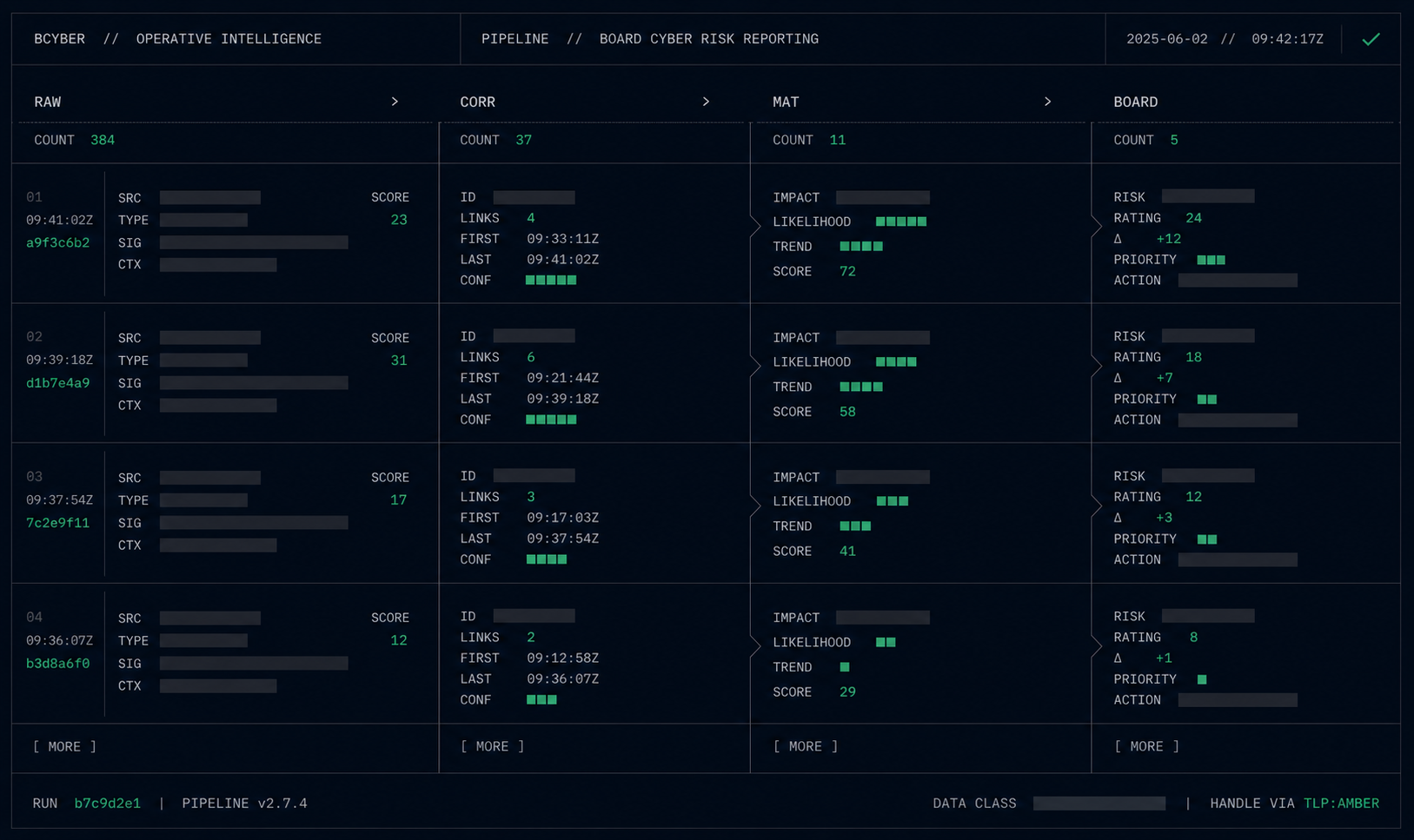
Board-level reporting should look very different from operational reporting. Operational reporting is full of tasks, tickets, and control activity, while board reporting should focus on themes, trends, material exposures, and whether the organisation’s posture is getting better or worse. A concise dashboard, a short narrative, and a few well-chosen scenarios are usually more useful than a long deck of technical detail.
The GRACE Portal is well suited to this level of reporting because it centralises executive dashboards, compliance tracking, and cross-product analytics in one place. In a board setting, that matters because the question is not “how many tools are deployed?” but “what does the business know, what are we doing about it, and can we prove it?”
Using scenarios and tabletop exercises
Scenario analysis helps leaders understand how risk might materialise in the real world. A well-designed scenario might explore what happens if privileged accounts are abused, if a supplier outage affects a critical service, or if ransomware disrupts core operations during a peak business period. The value is not in predicting the future, but in rehearsing decisions before the pressure is real.
These exercises expose weak points in escalation, communications, dependencies, and recovery assumptions. They also help executives see that cyber readiness is a shared responsibility. BCyber’s Perfect Storm scenario intelligence is relevant here because it supports compound-threat modelling, impact analysis, resilience testing, and war gaming before the incident happens.
Tabletop exercises are especially valuable because they turn abstract concern into decision practice. They reveal who needs to be involved, which approvals slow the response, and what information leaders actually need in order to act. They also build confidence among executives who may never have managed a cyber crisis before. The CISO can use those exercises to improve incident plans, crisis communication, and recovery sequencing.
Proving maturity through evidence
A mature program should be able to show its work. That means using maturity assessments, audits, validation testing, and control evidence to demonstrate whether key protections are actually operating as intended. The goal is not perfection, because no environment is static enough for that. The goal is informed confidence: a clear view of what is working, what is not, and what is being improved next.
BCyber’s CyberTriage supports that mindset during incidents by helping teams triage quickly, contain threats, and move into forensic analysis and playbook-driven response. Profiler adds a behavioural lens that can highlight insider risk, access anomalies, and unusual activity patterns that warrant deeper review. Together, those capabilities help turn “we think we are improving” into “we can evidence improvement.”
Continuous improvement should be built into the program, not bolted on after an incident. Lessons from incidents, near misses, tests, and external reviews should feed back into the roadmap and governance cycle. As the business evolves, so must the security strategy, because new services, new suppliers, and new technologies create new dependencies. The strongest CISOs do not promise immunity; they build adaptability.
Authoritative sources and public guidance used in this article
This article draws on public guidance from:
- APRA CPS 234 – Information Security
- ACSC Essential Eight
- ACSC Strategies to Mitigate Cyber Security Incidents
- NIST Cybersecurity Framework 2.0
- NIST SP 800-37 Rev. 2 – Risk Management Framework
- ISO/IEC 27001 overview
- OAIC Privacy guidance
Key Takeaways
- CISO strategy and leadership is about turning cybersecurity into a business capability, not a standalone technical function.
- The strongest programs start with business objectives, then map critical assets, risk scenarios, and control priorities to those objectives.
- Governance gives strategy teeth by defining risk appetite, decision rights, exception handling, and evidence-based accountability.
- A practical roadmap aligns budget, resources, and metrics to the risks that matter most, rather than spreading effort too thin.
- Leadership credibility comes from clear communication, cross-functional collaboration, and proof that security is improving over time.
A CISO who leads well helps the business make better decisions under uncertainty. That means using governance to create consistency, using metrics to show movement, and using evidence to prove the program is doing real work. It also means recognising that cyber resilience is a shared capability, built across teams and strengthened through repeated learning.
Verification note: Platform inventory figures in this article reflect BCyber internal records as of 16 June 2026: 21 policies, 8 processes, 46 courses (2 enrollments), 618 published articles, 365 knowledge hub entries, 9 clients, and 8 fact-find assessments. These numbers are operational inventory data, not audited market benchmarks.
Awards and recognition referenced: BCyber was named a 2025 Finalist – GRC Provider of the Year, a 2025 Finalist – AI Innovator, Cyber Security, and Karen Stephens, Co-Founder & CEO, was a 2025 Finalist – Cybersecurity Professional of the Year.