Board Cyber Risk Reporting: How to Turn Technical Security Data into Clear, Decision-Ready Board Insight

By BCyber Security Team | CISSP, CISM Last updated: 3 August 2026
Boards do not need another wall of security metrics. They need a clear view of what cyber risk means for the business, what is working, what is failing, and what decisions deserve attention now. Too often, cyber teams deliver dashboards that look healthy but do not answer the questions directors actually ask in the room. The result is a reporting rhythm that creates activity without insight, and confidence without evidence.
This case study shows how a structured, evidence-based reporting model can turn technical security data into board-level governance value. The approach below reflects BCyber platform data at the time of writing, including 21 policies, 8 processes, 50 courses, 770 published articles, 374 knowledge hub entries, 9 clients, and 11 fact-find assessments. That evidence base informs the governance patterns described here, but organisations should validate all metrics against their own control environment and regulatory obligations.
Verification statement: Any operational figures, process examples, and platform references in this article are based on BCyber platform records and client delivery experience as of the last updated date. They are provided for governance education and should be independently validated before use in board papers or regulatory submissions.
Why Board Cyber Risk Reporting Became a Governance Problem
Directors need oversight, not operational noise
Board cyber risk reporting exists because directors are accountable for oversight, not for managing technical controls day to day. Their role is to understand whether cyber exposure is being reduced in a way that supports the organisation’s strategy, resilience, and compliance obligations. In Australia, that oversight often needs to align with frameworks such as APRA CPS 234, the Essential Eight, ISO/IEC 27001:2022, and the Privacy Act 1988, depending on the sector and operating model.
For APRA-regulated entities, CPS 234 requires information security capability commensurate with vulnerabilities and the threat environment, including evidence of control testing and notification obligations. For government and many critical-service environments, the ACSC Essential Eight provides a practical control baseline for reducing common attack paths such as phishing, privilege misuse, and unpatched systems. When reporting does not connect cyber activity to those responsibilities, the board is left with fragments instead of a meaningful governance picture.
The reporting gap usually starts with good intentions
In many organisations, cyber teams report what they can measure easily rather than what directors need to know. That often means vulnerability counts, patch percentages, alert volumes, or control status indicators that are technically accurate but business-light. The problem is not that these measures are useless; the problem is that they are rarely translated into financial, operational, regulatory, or reputational impact.
In a financial services firm, for example, “92% patch compliance” may sound acceptable until directors learn that the remaining 8% includes internet-facing systems supporting payment processing. In healthcare, a delayed identity-system patch might carry very different implications if it affects clinical systems, patient records, or incident escalation pathways. Boards then receive either too much detail or too little narrative, and both outcomes weaken governance.
What “good” looks like in practice
A useful board report should explain current exposure in business terms, show whether controls are effective, and identify the exceptions that require attention. It should also show movement over time, so the board can see whether risk is reducing, persisting, or worsening. Most importantly, it should make the decision points obvious, whether those relate to budget, risk acceptance, policy change, or supplier governance.
In other words, reporting should function as a governance tool rather than a technical scorecard. That is the difference between being informed and being able to act.
The strongest board cyber reporting does not promise certainty. It shows evidence, context, and the next decision.

What a Decision-Ready Cyber Report Needs to Show
Business-aligned risk framing makes the data usable
The board does not need to understand every alert type or tooling nuance, but it does need to understand what could happen to critical services if cyber controls fail. That means cyber risks should be framed around business services, key assets, and enterprise objectives rather than isolated technical events.
A good report connects attack scenarios to consequences such as operational downtime, revenue interruption, regulatory exposure, customer impact, and third-party dependency risk. In government, for instance, service outages in citizen portals can create downstream impacts on service delivery, backlog, and public trust. In a healthcare setting, cyber disruption may affect medication workflows, triage, or access to diagnostic systems. When directors see cyber issues through that lens, they can compare them against other enterprise risks more naturally.
Control effectiveness matters more than control existence
It is common for reports to say that a control exists, but existence alone does not prove that it works. A board-ready report should explain whether controls are operating effectively, whether exceptions exist, and whether testing supports the claim.
Evidence can come from internal audit, external audit, penetration testing, incident response exercises, vulnerability remediation performance, and backup recovery tests. If the organisation says privileged access is tightly managed, the board should be able to see what testing supports that statement and where exceptions still exist. This is the essence of control effectiveness reporting and aligns closely to NIST Cybersecurity Framework 2.0 and ISO 27001 Annex A expectations around verification and continual improvement.
Trends tell a more honest story than snapshots
Point-in-time reporting can hide drift, delay, and repeated remediation failure. Directors need trend context so they can see whether the organisation is improving or merely maintaining an appearance of stability. A rising number of overdue high-severity vulnerabilities, for example, tells a different story from a temporarily elevated count that is being actively cleared within tolerance.
Trend lines also help boards distinguish between a one-off incident and a pattern that requires structural change. In practice, trend reporting creates better conversation because it shows movement rather than isolated numbers.
Exception-based reporting keeps attention on material risk
Boards do not need to review every issue equally. They need to focus on the risks that exceed tolerance, the policy exceptions that remain unresolved, the audit findings that are overdue, and the remediation plans that have slipped. Exception-based reporting keeps the narrative clean and makes escalation meaningful. It also helps leadership avoid drowning the board in operational detail that belongs elsewhere.
Clear decisions should be visible in every report
A report becomes more valuable when it ends with a decision, even if that decision is simply to note progress and maintain current funding. In many organisations, the reporting content is strong but the decision framing is weak, which leaves directors unsure what is expected of them. The report should state whether funding, risk acceptance, policy change, supplier action, or remediation prioritisation is required. It should also specify the owner and timeframe for each material item. That creates accountability without confusion.
Building the Reporting Model from Technical Data to Executive Insight
The first step is knowing who the report is for
Board reporting should not be built as a recycled version of the operational security dashboard. Different audiences need different layers of detail, and the report should reflect that discipline. Directors need material risk, trend movement, control effectiveness, and decisions. Audit and risk committees often need deeper evidence, governance status, and remediation progress. The C-suite needs enough operational context to support prioritisation and resource allocation without being buried in tactical noise.
This is where BCyber’s GRACE Portal is relevant: as a Unified Cyber Resilience Platform, it brings together Single Dashboard, Cross-product Analytics, Executive Reporting, Compliance Tracking, and Real-time Monitoring. In practical governance terms, that supports the board layer, committee layer, and operational layer without forcing each audience to work from a different version of the truth.
Standardising the cyber risk taxonomy improves consistency
A strong reporting model uses a common language for risk categories so that every team is speaking from the same forest rather than separate clearings. Typical categories might include threat exposure, vulnerability severity, control maturity, incident impact, recovery capability, and third-party risk. These categories should be stable enough to support comparison over time, but flexible enough to adapt to the organisation’s sector and threat profile.
Avoiding vague or overly technical labels matters because the board must be able to understand what each category means without translation. A shared taxonomy also improves auditability and helps different business units report consistently.
Business impact modelling turns cyber into enterprise risk
Cyber events become more meaningful when they are linked to actual business consequences. That can include downtime, lost revenue, response cost, recovery expense, regulatory response, customer churn, and operational backlog. In sectors such as finance, healthcare, and critical services, the consequences can be especially material because interruption affects both service delivery and trust.
Scenario-based modelling helps boards think through what happens if a key identity platform fails, a third-party provider is compromised, or backup restoration is delayed. BCyber’s Perfect Storm scenario intelligence platform supports this type of modelling through scenario simulation, impact analysis, resilience testing, and war gaming. The aim is not to predict the future with certainty, but to create a credible frame for decision-making.
Quantification helps compare trade-offs
Risk quantification is useful when the board needs to compare one exposure against another, or when leadership must choose between competing investments. Paradigm, BCyber’s AI Self-Learning GRC Platform, supports that kind of thinking by enabling risk quantification, policy automation, and compliance mapping through its Synapse AI Engine.
Quantification does not replace judgment, but it gives the board a more structured way to compare inherent risk against residual risk. It also helps clarify where additional investment is likely to reduce exposure most effectively. When numbers are tied to business context, they become a tool for prioritisation rather than a false promise of precision.
A good reporting cadence keeps governance alive
A board cyber report should not appear only when a crisis hits. Monthly or quarterly board packets create rhythm, while exception reporting allows significant incidents or control failures to surface quickly. Annual deep dives are also useful for maturity planning, resilience review, and investment alignment.
This cadence matters because governance is a living system, not a one-time artifact. As the business changes, the report should evolve alongside it.

Why Evidence Changes the Quality of Board Conversation
Evidence creates trust where reassurance cannot
Boards should not have to accept verbal assurance at face value. In cyber governance, claims are only useful when they can be supported by testing, outcomes, and a traceable evidence trail. That is the heart of proof not promises.
If a team says recovery capability is strong, the board should see the backup test results, the recovery time performance, the failure points, and the remediation action if something did not work as planned. Evidence does more than validate a claim; it helps directors understand the reliability of the control environment.
The best evidence sources are practical and repeatable
Strong board reporting draws from multiple evidence streams so that no single measure carries the whole story. Useful sources include audit findings, tabletop exercises, vulnerability management trends, incident response performance, third-party risk assessments, security awareness outcomes, and recovery testing. Each source contributes a different angle on resilience, and together they create a more complete picture.
For example, phishing awareness completion alone is not enough unless it is paired with behavioural outcomes and incident reduction evidence. BCyber’s Profiler platform adds that behavioural layer through user activity analytics, access pattern monitoring, risk scoring, and insider threat detection. That can be particularly valuable in environments where human-factor risk is a dominant driver, such as finance and healthcare.
Translating evidence into board language is where value appears
A phrase like “MFA is deployed” sounds reassuring, but it does not tell the board what matters most. A better report would show coverage across critical systems, the exceptions that remain, the rollout issues that caused delay, and any evidence of reduced credential-based attack paths. Likewise, saying “we are compliant” is less helpful than showing which controls are compliant, which are overdue, and what residual risk remains despite compliance status.
This kind of translation turns technical activity into decision-ready insight. It is a small change in wording, but a large change in governance value.
Transparency is more persuasive than polished messaging
Board trust grows when teams report issues early and explain what is known, what is not yet known, and what is being done about it. That does not mean overloading the board with uncertainty; it means presenting the facts with enough honesty to support action. When remediation is delayed, the report should say so clearly and show the milestone plan. When an incident is still under investigation, the board should understand the current impact and the next update point.
Transparency does not weaken confidence; it strengthens it because it proves the organisation can govern reality, not just messaging.
The wrong metrics can make a good team look average, or worse
Vanity metrics often fill the gap when reporting is not designed around risk. Counts of tickets closed, alerts generated, or awareness modules completed may be useful operationally, but they do not necessarily reflect risk reduction. A board may see a green status and assume everything is under control, even when critical exceptions remain unresolved.
That is why metric selection matters so much. If a measure does not support a decision, it probably belongs in the operational layer, not the board pack.
How BCyber Supports Executive Reporting and Continuous Governance
GRACE Portal provides the executive reporting layer
BCyber’s GRACE Portal is designed to consolidate governance information into a single executive view. Its value lies in bringing together Executive Reporting, Compliance Tracking, Cross-product Analytics, and a Single Dashboard so that reporting is no longer scattered across disconnected tools and spreadsheets.
For board purposes, that means less manual assembly and more consistent interpretation. It also means leadership can see patterns across risk, compliance, and resilience in one place rather than chasing separate reports. For organisations trying to improve board cyber oversight, that consolidation is often the turning point.
Paradigm strengthens the reporting lifecycle
Paradigm extends the governance model by supporting risk quantification, policy automation, and continuous compliance mapping. That matters because board reporting works better when the underlying governance engine is always running rather than assembled at quarter end.
Automated policy and control mapping also make it easier to maintain evidence trails and track exceptions over time. In practical terms, this helps the board receive a more stable view of exposure and a more credible view of progress. The reporting becomes less reactive and more resilient.
The tools matter because they improve the evidence chain
When reporting is assembled manually, small inconsistencies can create larger governance problems. One team may define risk differently from another, or one report may use an outdated control status while another uses current data. GRACE Portal helps reduce that fragmentation by acting as the reporting layer for executive visibility.
Paradigm adds continuity by linking governance actions to measurable outcomes over time. Together, they help create a more trustworthy flow of evidence from operational activity to board-level insight.
BCyber’s governance content ecosystem strengthens implementation
BCyber’s platform inventory includes 21 policies, 8 processes, 50 courses, 770 published articles, and 374 knowledge hub entries, which means reporting can be reinforced with a broader governance and awareness ecosystem rather than a one-off template. Relevant capability-building examples include:
- Policy design and control mapping through Paradigm
- Executive governance reporting through GRACE Portal
- Behavioral risk visibility through Profiler
- Incident response triangulation through CyberTriage, which supports 4-minute triage for rapid containment and investigation
- Scenario planning through Perfect Storm
- Forecasting and capacity planning through TopSpin
- Privacy governance through Privacy in Depth, especially relevant for Privacy Act and regulated data handling obligations
BCyber also uses training and enablement content aligned to governance maturity, including courses that support board reporting, policy interpretation, cyber risk management, incident response, and privacy obligations. In a mature program, these learning assets matter because they reduce inconsistency in how risk is described and escalated.
Tooling alone is not enough
Technology supports governance, but it does not replace judgment, context, or leadership. The best reporting still depends on clear risk framing, sensible metric design, and thoughtful executive interpretation. That is why BCyber’s approach matters: tools are used to support evidence-based storytelling, not to automate away accountability. In a healthy reporting model, the dashboard informs the conversation, but the governance question remains human. That balance is what keeps the reporting useful rather than merely automated.
A Practical Case Narrative: From Fragmented Updates to Board-Ready Insight
The starting point was familiar
The organisation in this case study began with fragmented cyber reporting across different teams and tools. Operational teams reported technical activity, compliance teams reported status against obligations, and leadership received summaries that did not always align. Board papers looked orderly on the surface, but they did not clearly show which risks were material or how control performance related to business impact.
This pattern is common in organisations operating across multiple regulatory overlays. For example:
- An APRA-regulated financial services firm may need to evidence CPS 234 control effectiveness and incident readiness to directors and auditors.
- A state government department may need to show Essential Eight uplift progress, supplier assurance, and service continuity risk.
- A healthcare provider may need to report on identity access, clinical system resilience, and privacy obligations under the Privacy Act and relevant health records requirements.
The result was predictable: directors asked for clarification, executives spent time reconciling versions, and reporting cycles became more labour-intensive than they needed to be. The security function had data, but not a unified governance story.
The challenge was to make risk visible and actionable
Leadership needed a way to evidence control effectiveness, prioritise remediation, and show how cyber risk was changing over time. They also needed reporting that could support compliance obligations without pretending compliance equalled resilience. The existing process lacked a stable taxonomy, had inconsistent narratives, and did not clearly tie security activity to business outcomes. That made it difficult for the board to decide where to focus attention or when to accept residual risk. The reporting problem was therefore not cosmetic; it was a governance problem.
The approach focused on structure, evidence, and consistency
The team introduced a reporting model built around board priorities rather than technical convenience. Risk categories were standardised, evidence sources were formalised, and every material issue required an owner, a due date, and a remediation path. BCyber’s governance framework was used to structure the workflow, including policies and processes already embedded in the platform inventory.
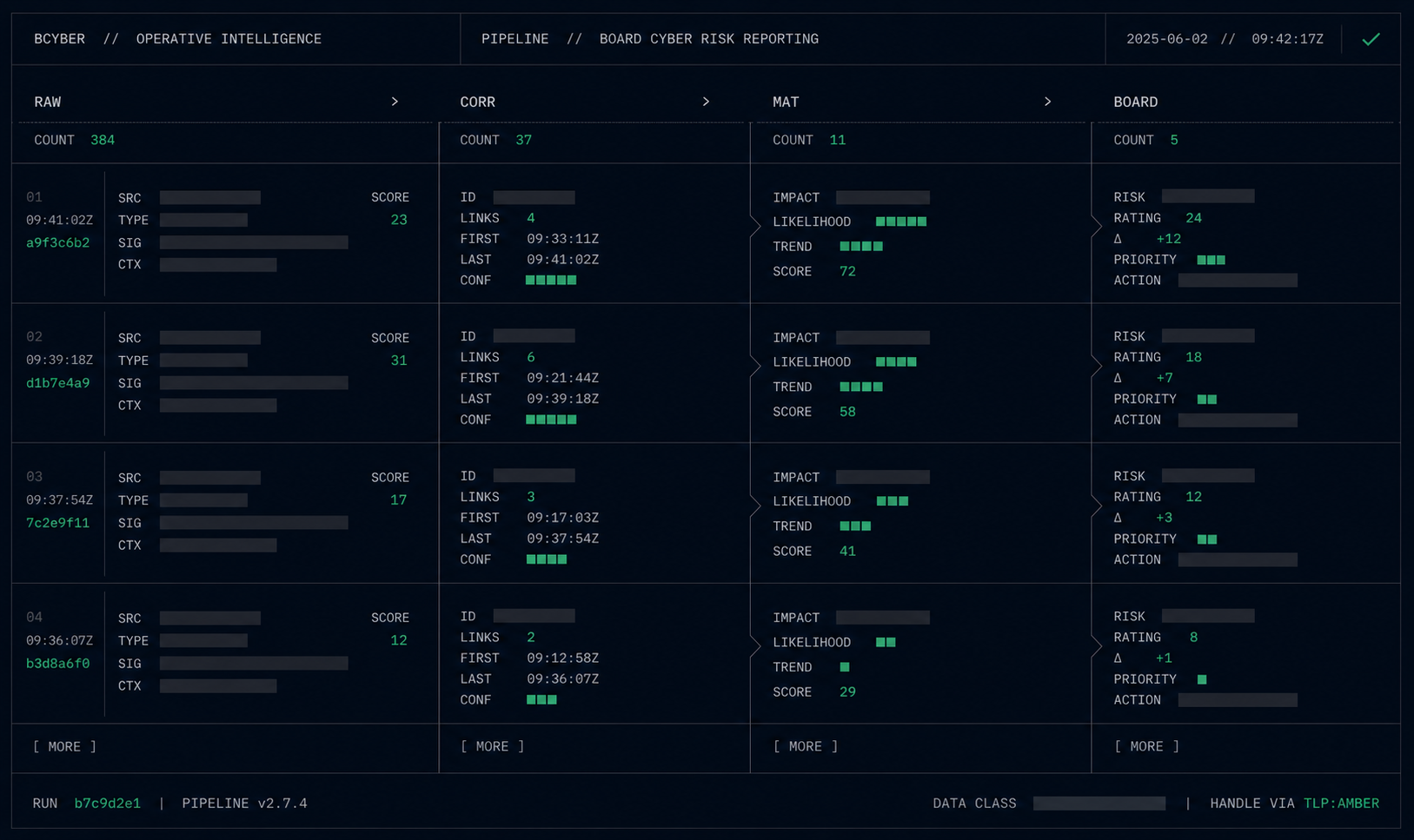
At the practical level, GRACE Portal was used to bring executive reporting, compliance tracking, and cross-product analytics into a single dashboard view. Paradigm supported quantification and automated governance workflows so that material issues could be tracked continuously rather than manually reconstructed each cycle. The model was designed to be repeatable, auditable, and understandable across security, risk, audit, and leadership audiences.
The outcome was a more useful board conversation
Once the reporting structure changed, the board no longer had to interpret disconnected technical measures. Directors could see which risks were above tolerance, where control performance was improving, and which exceptions required action. The board conversation became more direct because the report already did the translation work. Instead of asking what the numbers meant, directors were able to focus on what decisions needed to be made.
That shift improved the quality of governance without adding noise.
The practical gains were operational as well as strategic
The reporting process became less manual, which reduced the effort required to prepare board packs and reconcile conflicting inputs. Exception handling improved because issues were surfaced earlier and tracked more consistently. Audit and compliance conversations also became easier because the evidence trail was visible and easier to trace. Over time, this created stronger alignment between cyber, risk, compliance, and executive leadership. The organisation did not just improve reporting; it improved its governance posture.
How BCyber’s Market Position Supports the Governance Approach
BCyber’s governance and AI-enabled cyber portfolio has received external recognition, including:
- 2025 Finalist – Cybersecurity Professional Of The Year for Karen Stephens, Co-Founder & CEO
- 2025 GRC Provider of the Year — Finalist
- 2025 AI Innovator - Cyber Security — Finalist
These recognitions are relevant because board reporting is increasingly expected to combine governance discipline with evidence-driven automation and decision support. That said, awards do not replace independent validation. They should be viewed as signals of market credibility, not proof of fit for a specific organisation.
Making Board Reporting Sustainable Over Time
Consistency matters more than cosmetic polish
A sustainable board reporting model uses the same structure often enough that trends become visible and comparisons become meaningful. That usually means a stable sequence covering risk overview, top issues, trend movement, control status, compliance posture, and decisions required. When the shape of the report changes every cycle, the board spends energy re-learning the format instead of understanding the risks. Consistency makes the report easier to read and easier to trust. It also supports stronger auditability over time.
Accountability must be built into every material risk
A good report should make ownership visible without ambiguity. Every material issue should have an owner, a deadline, a mitigation plan, and a clear escalation threshold if the plan slips. That approach prevents issues from floating in the governance gap between teams and committees. It also helps the board see whether accountability is active or merely documented. In practice, accountability is one of the clearest signs that cyber governance is maturing.
Reporting should evolve with the enterprise risk model
Cyber reporting should not sit apart from the organisation’s broader risk framework. It should connect to enterprise risk management, financial planning, operational resilience, and strategic oversight. That connection helps directors compare cyber exposure with other business priorities in a coherent way. It also ensures that cyber reporting remains relevant as the organisation changes its technology stack, supplier relationships, and service model. A living governance model grows with the business instead of lagging behind it.
Improvement should be deliberate, not accidental
Boards should periodically ask whether the information they receive is still useful. Metrics that once seemed important may no longer drive decisions, while emerging risks may need new evidence streams or different framing. Regular review helps keep the report concise, focused, and decision-ready. It also gives leadership a chance to refine the narrative based on incidents, audit feedback, and strategic changes. In that sense, board reporting is not a fixed product; it is a living practice.
Practical Frameworks and Resources
For teams building or refreshing board cyber risk reporting, these references are useful starting points:
- APRA CPS 234 – Information Security: https://www.apra.gov.au/information-security-cps-234
- ACSC Essential Eight: https://www.cyber.gov.au/resources-business-and-government/essential-cyber-security/essential-eight
- NIST Cybersecurity Framework 2.0: https://www.nist.gov/cyberframework
- NIST SP 800-30 Rev. 1 Risk Assessment: https://csrc.nist.gov/publications/detail/sp/800-30/rev-1/final
- NIST SP 800-53 Rev. 5 Security and Privacy Controls: https://csrc.nist.gov/publications/detail/sp/800-53/rev-5/final
- ISO/IEC 27001:2022 overview: https://www.iso.org/standard/27001
- OAIC Privacy Act guidance: https://www.oaic.gov.au/privacy
Note on scope, independence, and potential bias
This article references BCyber platforms, content assets, and market recognition because BCyber requested an E-E-A-T-enhanced version of the original case study. As a result, the article contains a commercial perspective and should be read with that context in mind. Readers should validate any platform, process, or product claims against their own due diligence, procurement process, and control requirements. Where regulatory interpretation is involved, organisations should seek legal, audit, or specialist compliance advice.
Conclusion
Board cyber risk reporting works best when it behaves like a governance instrument rather than a technical scorecard. The organisation in this case study improved board insight by standardising risk categories, grounding claims in evidence, and using tools that brought fragmented data into a single executive view. GRACE Portal helped create that board-ready reporting layer, while Paradigm supported risk quantification and continuous governance automation.
The result was a clearer conversation about exposure, control effectiveness, and the decisions that mattered most. In a mature reporting model, evidence is what builds trust, and trust is what makes governance useful.
Key Takeaways
- Board cyber reporting should translate technical data into business risk, control effectiveness, and decision-ready insight.
- Proof not promises means every material claim should be supported by evidence from testing, incidents, audits, or resilience outcomes.
- GRACE Portal strengthens executive reporting by consolidating compliance tracking, cross-product analytics, and a single dashboard view.
- Paradigm supports continuous governance through risk quantification, policy automation, and ongoing compliance mapping.
- Sustainable board reporting is concise, consistent, exception-based, and aligned to enterprise risk governance.
- For Australian organisations, reporting should be mapped to APRA CPS 234, the ACSC Essential Eight, NIST, and ISO 27001 where applicable.